
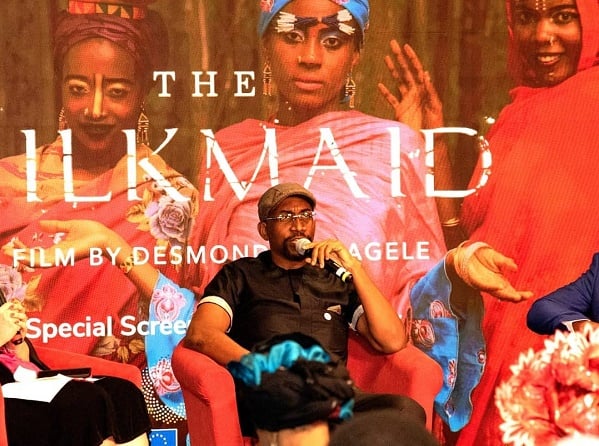

Desmond Ovbiagele’s trajectory, from the structured echelons of high finance to the dynamic heart of African storytelling, marks a distinctive chapter in the annals of Nigerian cinema. After more than a decade dedicated to investment banking, he transitioned from spreadsheets to storyboards, propelled by an innate creative impulse and a profound desire to contribute to the evolving narrative of Nollywood. His cinematic works, including the internationally recognised The Milkmaid and Render to Caesar, are distinguished by their engagement with stories of deep cultural and social resonance.
Ovbiagele’s career embodies a compelling fusion of discipline and artistic passion, where astute business acumen converges with ambitious creative vision. He is recognised for enhancing the technical and creative calibre of Nigerian filmmaking and has emerged as a significant voice advocating for comprehensive industry transformation. This includes addressing fundamental challenges such as funding, distribution, and global visibility. In this exclusive conversation, Ovbiagele offers considered insights into the intricate balance between artistic integrity and commercial viability, the nuanced impact of streaming platforms, and the enduring capacity of cinema to confront, reflect, and heal.
“I Was Restless—Spreadsheets Couldn’t Contain My Creative Side:Ovbiagele”
Kadry Al-Haggar: You transitioned from investment banking to filmmaking. What inspired this significant shift, and how has your financial background influenced your approach to cinema?
Desmond Ovbiagele: “I had worked in investment banking for over a decade, and whilst financially rewarding, I found myself increasingly restless and keen to explore other aspects of my temperament that naturally could not find full expression within the profession – specifically on the creative side.
New generation filmmaking in Nigeria was well into its second decade at this time and culturally quite popular, but certain critical elements of the process remained work-in-progress and I was inspired to contribute my quota of whatever quality in hopefully advancing the industry’s output technically and creatively.
My background in finance was certainly influential in creating a legal and administrative structure around my projects to facilitate fundraising, execute production, and secure distribution through the requisite patchwork of commercial contracts. It also provided me with the value system of diligence, professionalism and accountability in every aspect of the process that helped guide the projects through occasionally turbulent waters toward their destination.”
“I Use Film to Speak for the Overlooked, the Sidelined, and the Silenced”
Kadry Al-Haggar: The Milkmaid and Render to Caesar have both received international recognition. How do you select the themes for your films?
Desmond Ovbiagele: “Beyond the desire to entertain, themes of social and cultural relevance are frequently uppermost in my consideration of potential projects. This is in view of the variety of legacy and contemporary challenges characteristic to this part of the world, the limited means of the average citizen to confront and address them, and the enduring power of film as a medium to give expression to opinions and situations that may be overlooked, sidelined or in some cases suppressed by traditional and often-politicized channels of communication in society.
On the whole, the process of filmmaking is such an arduous journey, that I personally need to be 100% invested mentally and emotionally in the story themes to see them through to hopefully a rewarding actualization.”
Kadry Al-Haggar: African cinema is gaining global attention, yet significant challenges persist. What do you identify as the most substantial obstacles for African filmmakers today?
Desmond Ovbiagele: “As is obviously the case with filmmaking in other parts of the world, film production financing in Africa remains a considerable challenge to the industry realizing its full potential in terms of the scale and variety of narratives that deserve to be cinematically told.
A few organizations have recently taken steps to alleviate this problem (such as the African Export Import Bank through its CANEX initiative), but filmmaking ventures particularly of the variety endemic in this part of the world do not naturally lend themselves to the structural rigor of institutional lending and investing, and such well-meaning interventions are presently limited in scope and impact.
Related to this, of course, is the challenge of distribution. The avenues of revenue recoupment for African-themed and originated content remain severely constrained. Access to markets beyond the continent (even with international co-production projects) are confined by perceptions that its stories are not internationally relatable, whilst the low proportion of cinema infrastructure throughout the continent relative to its teeming population excludes the content’s access to the markets where it would resonate most strongly and profitably.
Of course, the limited cinema infrastructure in Africa is a consequence of the relatively low economic power of its constituent populations which disincentivizes investment in this area, and by extension, in the production of African-themed content of the scale and ambition that can compete effectively on the global stage.
By way of illustration, consider the recent phenomenon of the Chinese animated film Ne Zha 2, which just became the first non-Hollywood film to achieve over $2 billion in total box office receipts, 99% of which was generated from its domestic market alone. A key facilitator of this feat was the country’s aggressive buildout of cinema screens locally in therecent past which no doubt contributed to the 300 million ticket admissions for Ne Zha 2, representing a whopping 21% of its total population.
If a country such as Nigeria, for instance, had the wherewithal to attract a similar percentage of its 200 million population to patronize one of its locally produced titles at the going rate of roughly $3 per admission, the production would harvest $120 million strictly from within its own borders, versus a production cost typically at a minute fraction of that amount.”
“Streaming Gave Us a Lifeline—But It’s Also a Dangerous Comfort Zone”
Kadry Al-Haggar: Streaming platforms have undeniably changed the landscape of film distribution. Do you perceive them as more of a blessing or a potential threat to the sustainable growth of African cinema?
Desmond Ovbiagele: “Streaming platforms have been a boon to the African film industry to the extent that they have constituted a viable window for revenue recoupment by producers, as well as a safe haven from the vagaries of rampant piracy that had for several years plagued traditional distribution channels such as the DVD industry, especially in Nollywood.
Beyond simply licensing of content, the advent of streamer-commissioned Originals not only boosted the economic fortunes of the selected practitioners (and by default their professional collaborators and service providers), but also by necessity raised the creative and technical standards of the content produced in order to qualify for acceptance, whilst boosting the general profile of the industry globally.
On the other hand, the presence of the streamers has bred a complacency and an overdependence by industry players on the patronage of what are in essence near-monopolistic entities, placing them at a distinct disadvantage not only in negotiating the commercial terms of their content’s acquisition, but also in their creative autonomy and even their project selection decisions.
This obviously comes at the expense of pursuing homegrown distribution options such as expanding cinema screens or developing competitive locally owned streaming services. This threat was recently brought to the fore by the strategic decision of the two leading international streamers operating on the continent to discontinue the commissioning and funding of original African content, leaving the projects and aspirations of ambitious filmmakers across the continent in the lurch with little remedy.”
“Balancing Art and Commerce in Nollywood Is Still a Work-in-Progress”
Kadry Al-Haggar: Many Nollywood films are often geared towards achieving commercial success. Within this context, how do you navigate the balance between crafting artistically driven narratives and meeting market demands?
Desmond Ovbiagele: “Common perception in the Nollywood industry is that the market primarily demands humor and escapism particularly from locally produced films as a panacea to the stress of the domestic environment. Industry players have historically responded to this need with a robust array of content produced with an economy of time and resources to facilitate a continuous cycle of profitable recoupment and reinvestment.
However, with local filmmaking efforts increasingly under an international spotlight due to the entrance of the globalstreamers as well as the pervasiveness of social media, the trend amongst the more ambitious domestic productions is to explore opportunities within the confines of patently commercial stories to push the envelope on some of the key artistic elements such as cinematography, production design and editing, in a bid for professional recognition both locally and internationally.
The effectiveness of the approach has received some validation judging by the acceptance of a number of Nollywood produced titles into A-list festivals such as Toronto, Berlin and Sundance within the past decade compared to a pervasive absence historically.
However, it must also be acknowledged that the greater majority of these titles have both struggled to make an impact at the local box office as well as secure commercially viable international distribution. So it must be said that simultaneously satisfying the predispositions of both investors and industry critics remains a work-in-progress in Nollywood – as indeed it does in other parts of the world.”
Kadry Al-Haggar: What role do prominent film festivals and awards, such as FESPACO and the Africa Movie Academy Awards (AMAA), play in shaping the trajectory and future of African cinema?
Desmond Ovbiagele: “By virtue of the films they choose to honor and spotlight, FESPACO, AMAA, and similar festivals and award platforms have the opportunity to promote the development, production and distribution of stories of diverse themes and cultural backgrounds, thereby enriching the fabric of African cinema, serving to preserve its culture, whilst also constituting independent validation of the professional quality of individual filmmakers with the potential to facilitate future project collaborations and partnerships.”
Kadry Al-Haggar: Funding remains a principal challenge for filmmakers across the African continent. What innovative solutions or collaborative efforts do you believe could help to bridge this crucial gap?
Desmond Ovbiagele: “As I mentioned earlier, initiatives such as Afrexim’s CANEX are certainly a step in the right direction but may perhaps require some form of backstop government support to expedite broader penetration of such interventions.
Co-productions within and across the boundaries of the continent are also a potential way to access deeper and more sophisticated pools of financing in addition to dedicated private equity film funds. In reality, a combination of these and other options may be required to actualize the most ambitious and potentially impactful projects in view.
Also, it certainly wouldn’t hurt if the streamers could be persuaded to consider African-themed projects with strong potential for international resonance on a case-by-case basis for their Originals slate.”


