
By using this site, you agree to the Privacy Policy and Terms of Use.
Accept
DNE Africa
  • Home
  • Politics
    FB IMG 1787395204228
    Business

    Tanzania Surpasses Kenya in Installed Power Capacity After Julius Nyerere Hydropower Project

    By Ahmed Emam 2 Min Read
    original
    Politics

    UN Committee Calls for Reparations Over Transatlantic Slave Trade

    By Ahmed Emam September 1, 2026
    951fc888 367e 415b 8ba5 2c59694bd724
    CulturePolitics

    Sept. 1: A Day of Literary Legacy, Liberation, Resistance in Africa

    By Ahmed Emam September 1, 2026
  • Business
    Boosting Agricultural Entrepreneurship in Cameroon Strategies for Sustainable Growth scaled 1
    BusinessInsiderTechnology

    Scaling Agricultural Innovation Can Boost Africa’s Farmers, Jobs, Agriculture Advocate Tells DNE Africa

    Africa needs to overhaul its regulatory, financial and market systems to turn…

    By Ahmed Emam 4 Min Read
    615320010a50a493314605f21ba5205e
    Business
    Rwanda Central Bank Raises Policy Rate to 8.75% as Inflation Accelerates
    778985151 1641117850916101 6065291960460389285 n
    Business
    Tanzania’s Mo Dewji Explores Botswana Investments as Gaborone Seeks Regional Capital
    BRICS states advance unified agricultural satellite platform to monitor global food security
    Business
    BRICS states advance unified agricultural satellite platform to monitor global food security
    Delegates agree to develop Business4Land platform, Mongolia launches rangelands initiative at COP17
    BusinessScience
    Delegates agree to develop Business4Land platform, Mongolia launches rangelands initiative at COP17
  • Culture
  • Opinion
  • Technology
  • World
  • My Bookmarks
Reading: Sept. 1: A Day of Literary Legacy, Liberation, Resistance in Africa
Sign In
  • Join US
DNE AfricaDNE Africa
Font ResizerAa
  • Home
  • Politics
  • Business
  • Culture
  • Opinion
  • Technology
  • World
  • My Bookmarks
Search
  • Home
  • Politics
  • Business
  • Culture
  • Opinion
  • Technology
  • World
  • My Bookmarks
Have an existing account? Sign In
Follow US
© Foxiz News Network. Ruby Design Company. All Rights Reserved.
951fc888 367e 415b 8ba5 2c59694bd724

Sept. 1: A Day of Literary Legacy, Liberation, Resistance in Africa

Ahmed Emam
Last updated: September 1, 2026 7:56 am
By Ahmed Emam 5 Min Read
Share
SHARE

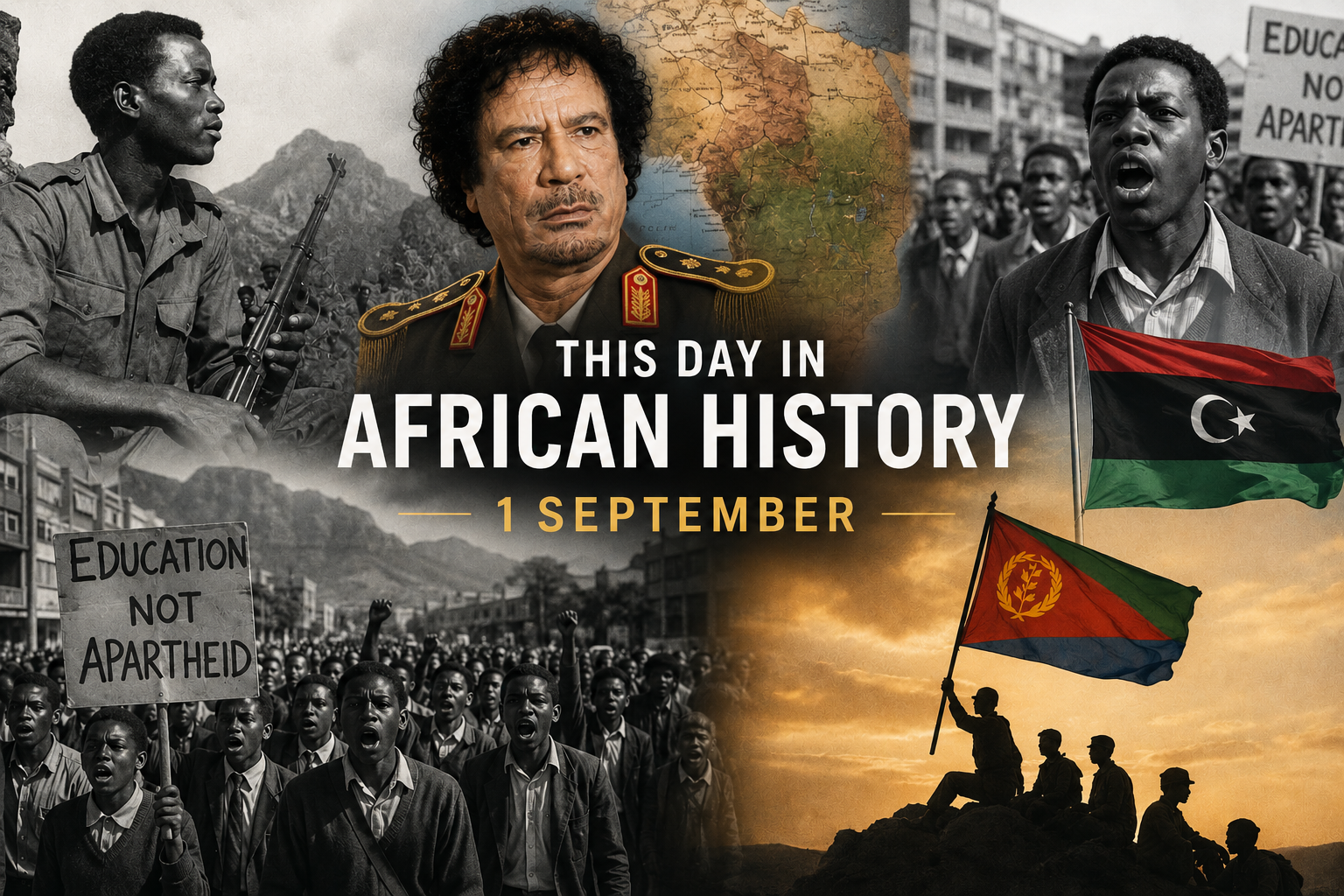
Sptember 1 carries a distinctive place in Africa’s modern history, linking the life of a celebrated Gambian writer and surgeon with political upheaval, a long-running independence struggle and student resistance against apartheid.

Contents
1932 — Lenrie Peters is born in The Gambia1961 — Eritrea’s armed struggle begins1969 — Libya’s monarchy falls1976 — Students take their protest to Cape Town

The date reflects some of the contrasting forces that have shaped the continent over the past century — from the intellectual and cultural contributions of African writers to struggles over political power, national sovereignty and social justice.

1932 — Lenrie Peters is born in The Gambia

On September 1, 1932, Lenrie Peters was born in Bathurst, now Banjul, The Gambia.

A physician, surgeon and writer, Peters built a career that crossed medicine and literature. He trained in Britain and became a Fellow of the Royal College of Surgeons, while also developing a reputation as one of West Africa’s notable literary voices.

His writing examined identity, colonialism and the social realities of post-colonial Africa. His novel The Second Round remains among his best-known works.

Peters was also active in education and held senior roles connected to the West African Examinations Council, contributing to the development of education in the region.

His career reflected the influence that African intellectuals could exert across several fields at a time when newly independent societies were seeking to define their institutions and cultural identities.

1961 — Eritrea’s armed struggle begins

Nearly three decades later, September 1 became associated with one of Africa’s longest liberation struggles.

In 1961, Hamid Idris Awate and a small group of Eritrean Liberation Front fighters confronted Ethiopian forces at Mount Adal in an encounter widely regarded as the beginning of Eritrea’s armed independence struggle.

Eritrea had been federated with Ethiopia under a United Nations arrangement after World War II. The federation was dissolved in 1962, and Eritrea was subsequently incorporated into Ethiopia, intensifying demands for independence.

The conflict continued for 30 years, involving successive liberation movements and resulting in significant political and humanitarian consequences.

Eritrean forces captured the capital, Asmara, in 1991, effectively ending Ethiopian rule. A UN-observed referendum two years later paved the way for Eritrea’s formal independence in 1993.

1969 — Libya’s monarchy falls

On September 1, 1969, Libya underwent a major political transformation when a group of young military officers overthrew the monarchy while King Idris was abroad receiving medical treatment.

The largely bloodless coup ended the Senussi monarchy and established the Libyan Arab Republic.

Muammar Gaddafi, then 27, emerged as the most prominent figure among the officers behind the takeover. He would remain Libya’s dominant political figure for more than four decades.

Under Gaddafi, Libya pursued an assertive foreign policy that increasingly focused on Africa. Tripoli developed close relations with several African governments and liberation movements, while Gaddafi later promoted a stronger pan-African political role for Libya.

His government’s involvement in African affairs made him an influential and divisive figure on the continent, particularly during the final decades of his rule.

1976 — Students take their protest to Cape Town

Seven years later, September 1 became another important date in Africa’s history of resistance.

Around 2,000 Black South African students from Langa, Nyanga and Gugulethu marched through central Cape Town in 1976, as student unrest spread across the country following the Soweto uprising in June.

The march was part of a broader wave of protests against apartheid and the government’s education policies. The September 1 demonstration proceeded without major obstruction, although subsequent protests in Cape Town were met with police action.

The student uprising of 1976 marked a turning point in the struggle against apartheid. Young South Africans increasingly became a driving force of political resistance, challenging the system both inside schools and across communities.

The events of that year would remain a defining chapter in South Africa’s history, with the courage of the students becoming an enduring symbol of resistance to apartheid.


You Might Also Like

UN Committee Calls for Reparations Over Transatlantic Slave Trade

Around 200 RSF Fighters Join Sudanese Army, Reports Say

August 30 in African History: Four Turning Points That Shaped the Continent

Niger Junta Regains Control After Armed Clashes in Niamey

African Leaders Push to Overhaul Peace Strategy as Regional Crises Mount

TAGGED:EritreaGambiaLibyaSept. 1South Africa
Share This Article
Facebook Twitter Pinterest Whatsapp Whatsapp LinkedIn Reddit Telegram Email Copy Link

You Might Also Like

How to Pay for Services with USD in Nigeria 1024x684 1
BusinessTechnology

5 African Countries Leading the 2026 Tech Boom

By Ahmed Emam 10 Min Read
images 7
Politics

Ghana Rejects MTN’s $1.8m Aid Offer as South Africa Tensions Deepen

By Ahmed Emam 3 Min Read
drc deplaces mai 2022.jpg
HealthPolitics

Conflict, Ebola Outbreak Deepen Displacement Crisis in Eastern DRC

By Ahmed Emam 2 Min Read

More Popular from DNE AFRICA

FB IMG 1787395204228
Business

Tanzania Surpasses Kenya in Installed Power Capacity After Julius Nyerere Hydropower Project

By Ahmed Emam 2 Min Read
Ad imageAd image
PoliticsWorld

UNICEF Warns Conflicts Are Putting Children’s Education at Risk Across MENA

The United Nations Children’s Fund (UNICEF) has warned that armed conflicts across the Middle East and…

By Ahmed Emam
Politics

Uganda Army Chief Muhoozi Kainerugaba Announces 2031 Presidential Bid

Uganda's Chief of Defence Forces Gen. Muhoozi Kainerugaba has announced plans to run for president in…

By Ahmed Emam
Business

BRICS states advance unified agricultural satellite platform to monitor global food security

BRICS member states are advancing plans to create a unified digital agricultural monitoring platform, with Russia…

By TV BRICS
BusinessScience

Delegates agree to develop Business4Land platform, Mongolia launches rangelands initiative at COP17

Delegates at the United Nations Convention to Combat Desertification (UNCCD) COP17 summit agreed to develop the…

By TV BRICS
DNE Africa

News by Africans, For Africans

Categories

  • The Escapist
  • Entertainment
  • Business

Quick Links

  • Advertise with us
  • Newsletters
  • Complaint
  • Deal

DNE Africa.All Rights Reserved.

Welcome Back!

Sign in to your account

Username or Email Address
Password

Lost your password?