
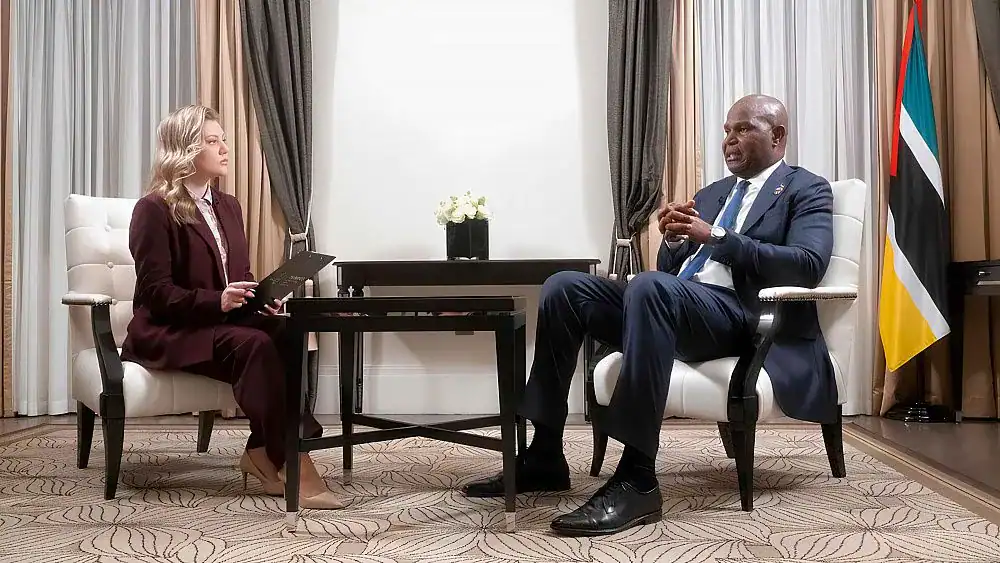

In an interview in Moscow, Mozambique’s President rDaniel Chapo pitched gas, hydropower and 31 million hectares of unused farmland to investors from Russia and the BRICS countries
“What we really need is investment so that we can fulfil our potential to become the energy hub of Southern Africa,” Mozambique’s President Daniel Chapo said.
Chapo spoke to TV BRICS in Moscow during the Russia–Africa Summit, in an interview with Janna Tolstikova, the network’s chief executive and editor-in-chief, for its BRICSterview series. He answered in Portuguese. The quotes below come from the English translation in the broadcast. Across 20 minutes, his message was that relations with Moscow are already strong on politics and need to grow on business.
From Liberation Ally To Trade Partner
Chapo said relations with Russia began well before the formal ties of 1975. “Russia is a country that helped us greatly in our struggle for national liberation,” he said. Mozambique established diplomatic relations with Moscow on 25 June 1975, the day it proclaimed independence. The two countries marked 50 years of ties in 2025.
“Political and diplomatic relations between Russia and Mozambique are excellent,” he said, “but now we need to turn our attention to our trade and economic relations.”
He said Mozambique’s economy remains heavily concentrated in extractive industries and gas, and that the government wants to diversify. He named agriculture, infrastructure, transport, logistics, energy, the blue economy, digitalisation and artificial intelligence as the sectors where it is seeking investment. He also listed Brazil, India, China and neighbouring South Africa as BRICS partners alongside Russia.
Power For The Region
Most of the interview concerned energy. Chapo said the Cahora Bassa hydroelectric plant already supplies almost all of Mozambique’s neighbours. The government plans to expand it through a second phase before building Mphanda Nkuwa, a new hydropower project of about 1,500 MW.
On gas, he said Mozambique has exported to South Africa for more than 20 years. A gas-fired power plant of about 450 MW is now under construction in Inhambane province, and a transmission line already serves Maputo. He said gas from the Rovuma Basin would allow Mozambique to build more gas-fired plants and export power across the region.
He also pointed to solar and wind potential, large coal reserves and exploration work to find out whether the country holds uranium deposits that could support further power plants. “To do that, we need investors,” he said. “That is why we have come here, precisely to find investors who can truly invest in our vision and in the resources we have.”
Mozambique: Farmland In Search Of Farmers
Chapo said Mozambique has about 36 million hectares of arable land and uses only about 15% of it. “Just think about it,” he said. “That’s a lot of land for growing all kinds of crops to feed the world.”
He named Gaza in the south, the Zambezi Valley and Manica in the centre, and Niassa in the north as the main food-production hubs. He said the goal is mechanised farming that feeds Mozambique first, then the region and export markets. He also said that in these areas crops can be grown without fertiliser, making organic produce possible.
He used the interview to invite large farmers, producers and agricultural investors “not only from Russia, but also from the BRICS countries, to invest in agriculture in Mozambique”.
To make the case for exports, he pointed to Mozambique’s three development corridors, each linking roads and railways to a port: Nacala in the north, Beira in the centre and Maputo in the south. “For anyone producing in Mozambique on an industrial scale to export anywhere in the world, logistics are very straightforward,” he said.
Students And Science
On education, Chapo recalled the Soviet teachers of mathematics, physics and chemistry who taught Mozambicans from school through university after independence. Mozambique still sends students to Russia and other BRICS countries. Within Africa, he named Algeria as a key partner for training. “It is not possible to develop a country without human capital,” he said.
Tourism Beyond The Beach
Chapo described Mozambique as “one of the most unspoiled” countries in the world. He pointed to its 2,700 km of coastline and listed Bazaruto, Massingir, Zinave, Gorongosa, Maputo, Niassa and the Quirimbas as its parks and conservation areas. He said Maputo National Park is one of the few places where visitors can see the Big Five and marine life in the same park.
He said international hotel groups are starting to arrive. Aman is building a luxury lodge at Massingir in Gaza province, and construction of a Singita lodge in Bazaruto is due to begin. He added that air links with Russia need work if more Russian tourists are to visit.
The full interview, produced by TV BRICS, is embedded above.


