
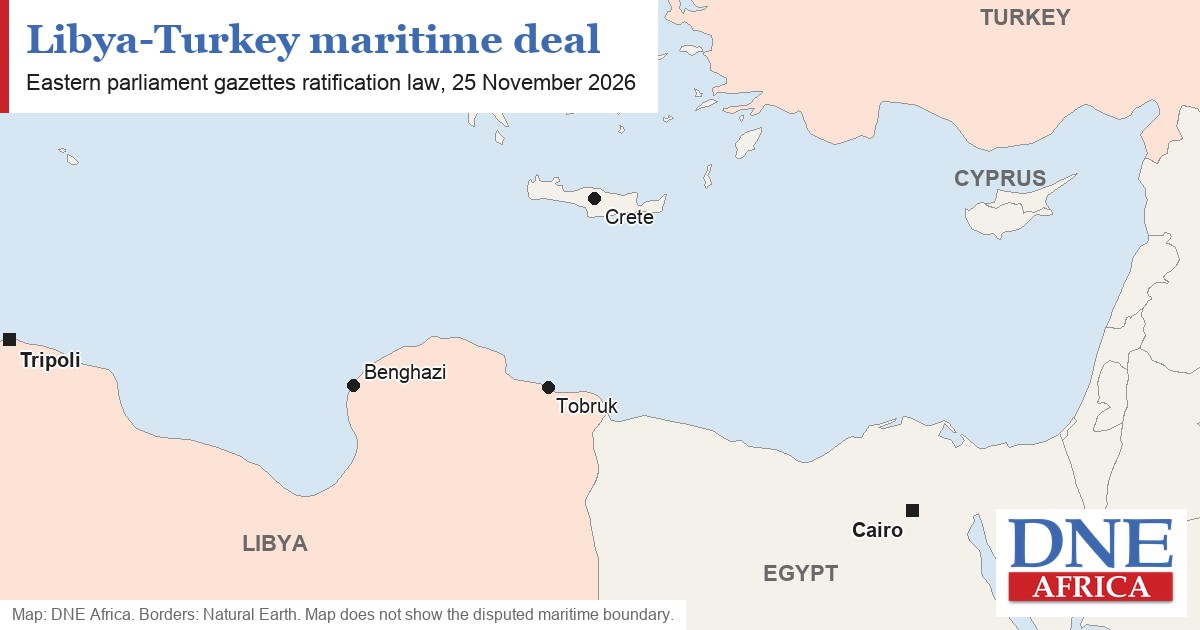

Libya’s eastern-based House of Representatives has published its law ratifying the 2019 Turkey maritime deal in the Official Gazette, completing a step that Egypt, Greece and the European Union rejected when the chamber voted for it in October.
The publication, carried by the state news agency LANA on Wednesday as Field Marshal Khalifa Haftar held talks in Ankara, gives the chamber’s reversal the force of a promulgated law in eastern Libya. Cairo and Athens say the Turkey maritime deal has no legal effect on their waters.
What does the published law say?
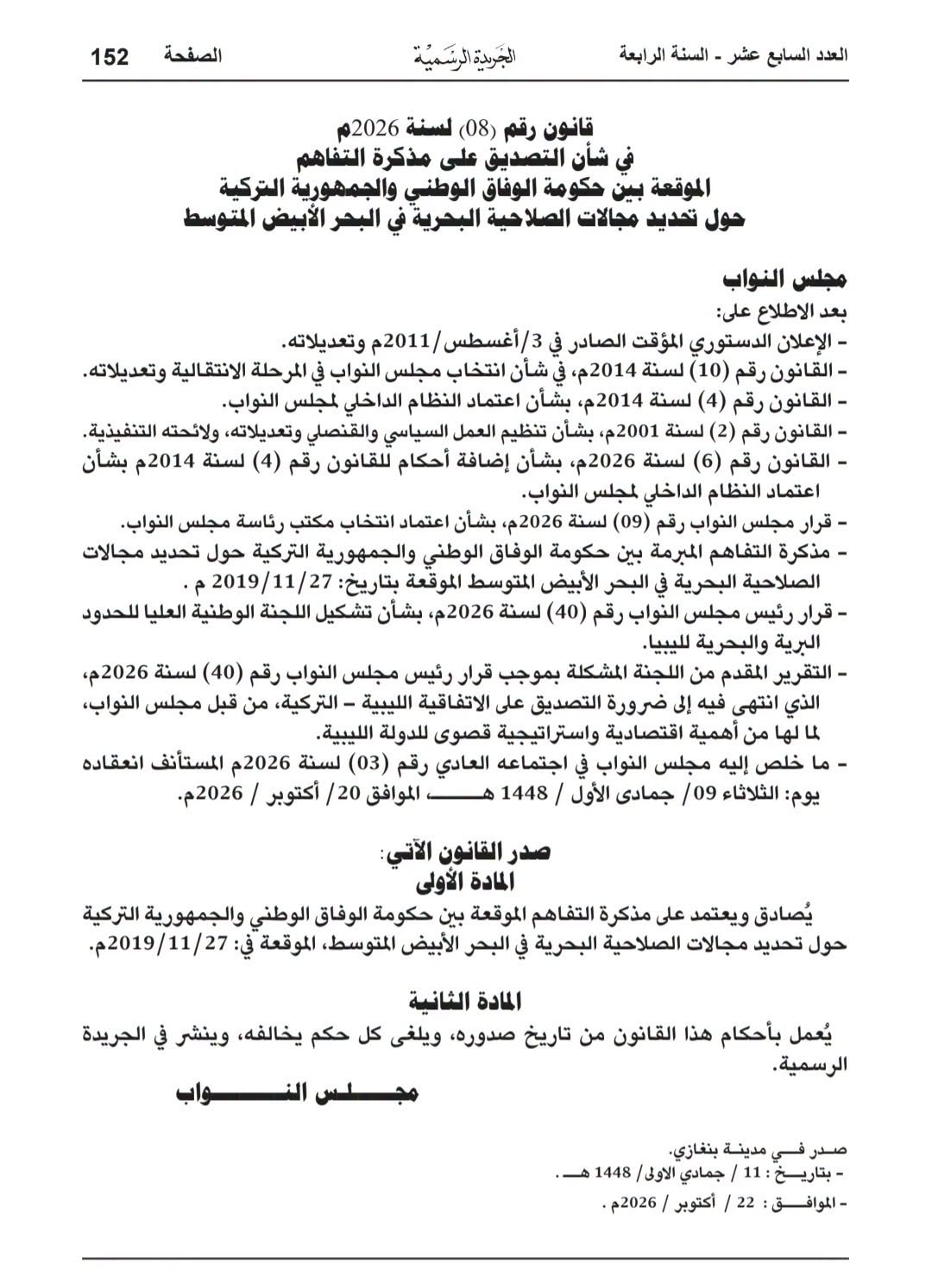
Law No. 8 of 2026 appears on page 152 of issue 17 of the Official Gazette, according to the page published by LANA. Its first article ratifies and adopts the memorandum on the delimitation of maritime jurisdiction areas in the Mediterranean, signed on 27 November 2019 by Turkey and Libya’s then Tripoli-based Government of National Accord. The second says it takes effect from the date of issue.
The law records that members approved the Turkey maritime deal at their session on Tuesday 20 October, and that it was issued in Benghazi on 22 October. It cites a report by the High National Committee for Libya’s Land and Maritime Borders, formed by the speaker this year, which recommended ratification because of the agreement’s “utmost economic and strategic importance” for the Libyan state (translated from Arabic). LANA said the gazette carried the full Arabic text of the agreement, including the coordinates of the two countries’ continental shelf and exclusive economic zone.
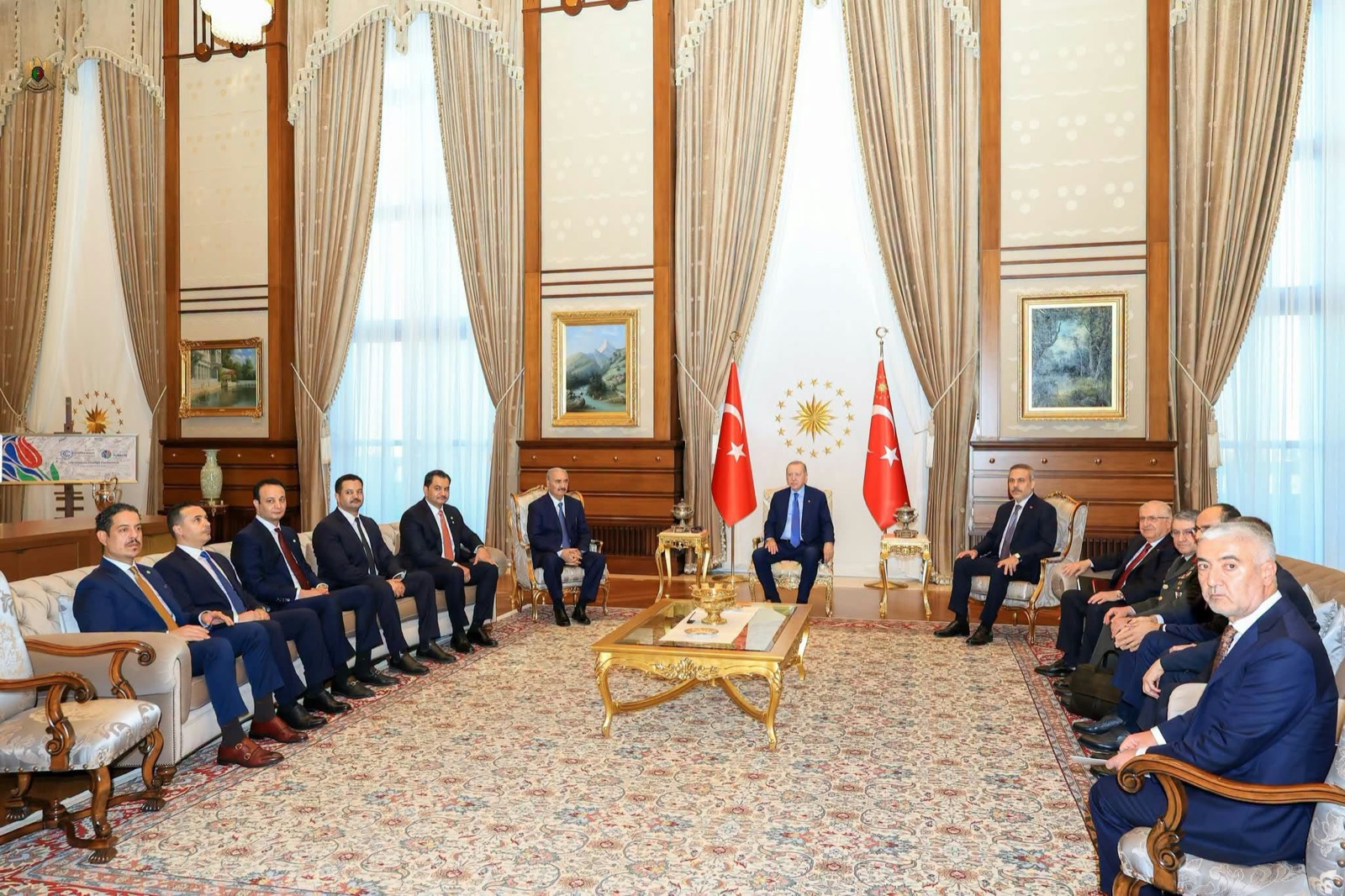
The October vote reversed the chamber’s 2020 decisions rejecting the memorandum and calling for political ties with Ankara to be cut. Turkey and the eastern camp, once on opposite sides of the war for Tripoli, have since moved closer. Mr Haftar met President Recep Tayyip Erdogan in Ankara on Wednesday, his first such visit, as DNE Africa reported.
How have Egypt and Greece responded to the Turkey maritime deal?
Egypt’s foreign ministry said on 21 October that the memorandum was “absolutely null and void” and had no legal effect for Egypt, adding that it infringed Egypt’s sovereign rights in its exclusive economic zone and continental shelf. Foreign Minister Badr Abdelatty repeated the position to his Turkish counterpart, Hakan Fidan, in Istanbul on 23 October, calling for respect for the 1982 UN Convention on the Law of the Sea; Mr Fidan said he understood Egypt’s concerns, the Egyptian ministry said.
In a note to the UN secretary-general dated 5 November, Egypt said the ratification did not change the memorandum’s status. It also rejected a 2022 hydrocarbons memorandum between Turkey and the Tripoli government, a 2025 memorandum between Libya’s National Oil Corporation and the Turkish Petroleum Corporation, and the outer limits of Libya’s maritime zones declared in May 2025, which it said overlapped Egypt’s western maritime limits.
Greece’s foreign ministry rejected the vote on 20 October, arguing that Turkey and Libya have no opposite or adjacent coasts that could provide a basis for delimiting maritime zones. A joint statement by Greece, Egypt, Cyprus, Bahrain, the United Arab Emirates and the EU, read by Greek Foreign Minister George Gerapetritis in New York, said the memorandum could not produce legal effects for third states. Mr Erdogan said criticism from the EU and others had no legitimate basis.
No new reaction from Cairo, Athens or the Tripoli-based Government of National Unity (GNU) to the gazette publication had been reported by early Thursday.
How have Libya’s rivals handled Egypt’s objections?
Both Libyan camps have sought to reassure Cairo without withdrawing from the Turkey maritime deal. Days after the vote, the eastern-based government of Prime Minister Osama Hammad urged parliament to back talks between Libyan and Egyptian technical committees on land and maritime boundaries, and the House issued a statement stressing that the two countries’ security was closely linked. In Tripoli, GNU Prime Minister Abdulhamid Dbeibah told Egypt’s intelligence chief, Hassan Rashad, that his government was ready to address Egypt’s concerns over maritime boundaries through dialogue.
Egypt and Greece signed their own partial maritime boundary agreement in August 2020, which overlaps areas claimed under the Libyan-Turkish memorandum. Greece says it remains ready to negotiate with Libya.
What happens next?
Attention now turns to whether Libyan institutions act on the Turkey maritime deal, for example through licensing in waters it covers. Tripoli is due to host an Africa-Turkey partnership summit on 8-9 December, which Mr Erdogan is expected to attend, according to Turkish media. Eastern officials have meanwhile asked the UN to investigate attacks on Benghazi port this month.
FAQ
What is the Libya-Turkey maritime deal?
It is a memorandum signed on 27 November 2019 by Turkey and Libya’s then Government of National Accord that delimits the two countries’ maritime jurisdiction areas in the Mediterranean.
What changed on 25 November?
The House of Representatives published Law No. 8 of 2026, ratifying the Turkey maritime deal, in the Official Gazette. The chamber had approved it on 20 October and issued the law on 22 October.
Why does Egypt reject the Turkey maritime deal?
Egypt says the memorandum is null and void and infringes its sovereign rights in its exclusive economic zone and continental shelf, contrary to the 1982 UN Convention on the Law of the Sea.
Who else objects?
Greece, Cyprus, Bahrain, the UAE and the EU joined Egypt in a statement saying the memorandum cannot produce legal effects for third states. Turkey rejects the criticism.


