
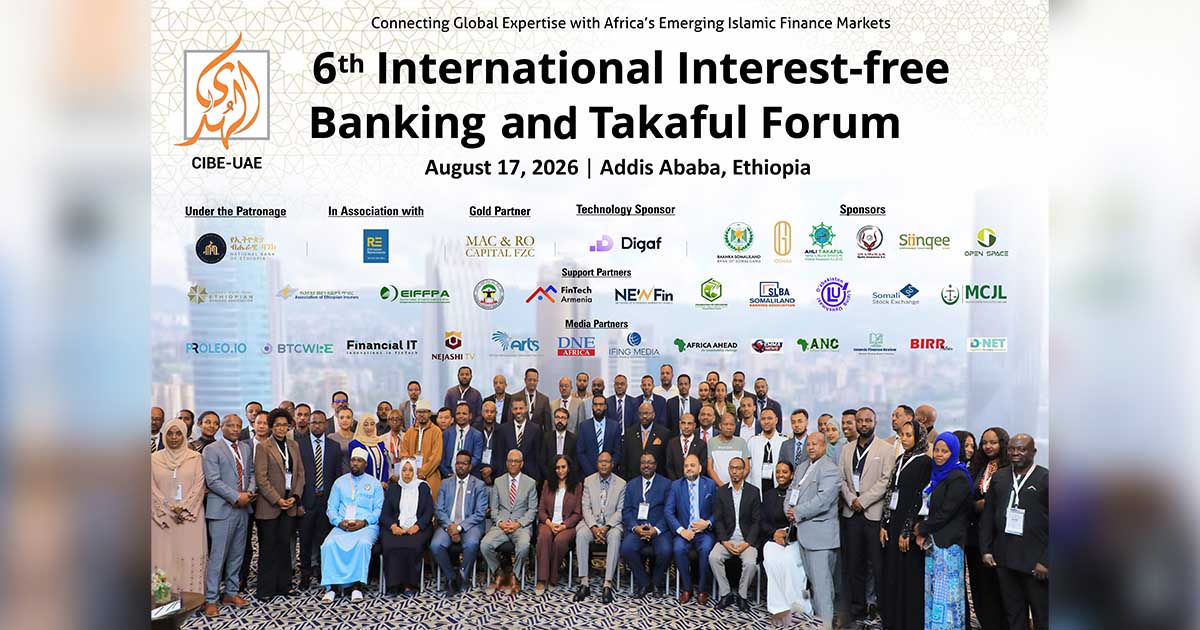

When approximately 800 Ethiopian finance professionals registered for a specialised online development programme earlier this year, it signalled a quiet but substantial shift in the country’s banking landscape. That growing local appetite for ethical financial expertise materialised on a global scale on 17 August 2026, when delegates from 20 nations gathered at the Hyatt Regency in Addis Ababa to map the future of the continent’s Shariah-compliant banking architecture.
The 6th International Interest-Free Banking and Takaful Forum, convened by the AlHuda Centre of Islamic Banking and Economics (AlHuda CIBE), assembled central bank regulators, FinTech pioneers, and Shariah scholars to debate the mechanics of ethical finance. DNE Africa also joined the high-level gathering, serving as a dedicated media partner for the event.
Behind the high-level panels lies a pressing economic objective. With an African population exceeding 1.4 billion and a vast proportion remaining outside the formal banking system, Ethiopia is aggressively positioning itself as a continental hub for interest-free banking and Takaful (Islamic insurance). By overhauling regulatory frameworks and championing digital financial services, the nation is moving to bridge critical financial inclusion gaps and attract new streams of international investment.
Bridging the Human Capital Deficit
While customer demand and regulatory adjustments provide a foundational base for the sector, industry leaders caution that long-term viability requires a deeply trained workforce.
Muhammad Zubair, Chief Executive Officer of AlHuda CIBE, noted that while the Ethiopian market shows immense promise, the structural deficit in specialised human resources must be addressed. AlHuda CIBE has been a historical catalyst in the region, having previously assisted in launching Ethiopia’s first three Takaful window operations.
“The future growth of interest-free banking and finance in Ethiopia will depend not only on expanding institutions and products, but also on developing a strong pool of qualified professionals,” Zubair said, pointing to the 800 local enrollees in their digital training initiative. “The participation… is an encouraging sign and will contribute toward addressing the human-resource and professional-capacity gap in the interest-free finance industry.”
Regulatory Backing and Financial Market Infrastructure
To accommodate this emerging financial vertical, the National Bank of Ethiopia (NBE) is executing sweeping institutional transformations. Policymakers are looking beyond standard retail banking, eyeing capital markets and micro-insurance frameworks to shelter lower-income demographics.
Solomon Desta, Vice Governor for Financial Stability at the NBE, credited international advisory partnerships for laying the groundwork of the sector. He stressed that the central bank’s horizon includes deep structural market reforms, such as the impending maturation of the Ethiopian Securities Exchange.
“We are committed to the continued development of regulatory frameworks towards interest-free banking and Takaful, recognizing their vital role in financial inclusion alongside instruments like Micro Takaful,” Desta stated. “With the development of our capital market and the Ethiopian Securities Exchange, our future is focused on more inclusion.”
Cross-Border Expansion and FinTech Integration
The forum also highlighted the necessity of technological integration and cross-border synergy. To embed digital infrastructure into the Islamic finance space, AlHuda CIBE formalised cooperation agreements with Digaf MFI, a technology sponsor, and the Capital Financial Excellence Center (CaFEC) S.C. These pacts are designed to fast-track the deployment of digital onboarding and smart-contract solutions for underserved communities.
Simultaneously, traditional insurers are adapting to the Shariah-compliant model. Dr. Yared Mola, President of the Association of Ethiopian Insurers, observed a steady upward trajectory in alternative insurance products, stating that public education and product innovation remain critical next steps. “Since the introduction of Takaful by AlHuda CIBE in Ethiopia, we have witnessed increasing growth in the sector,” he said.
The momentum generated in Addis Ababa is already expanding outward. During the event, organisers officially inaugurated the forthcoming 12th African Islamic Finance Summit, set to take place in Hargeisa, Somaliland.
For regional policymakers, the collaborative environment is a necessary stepping stone. As Abdirahman Omar Ibrahim, Director of Public Debt Management at the Central Bank of Somaliland, noted: “This Forum provides a valuable opportunity to share our experience and learn from the global expertise gathered here, which will further strengthen our efforts in developing a robust and inclusive interest-free financial sector.”


