
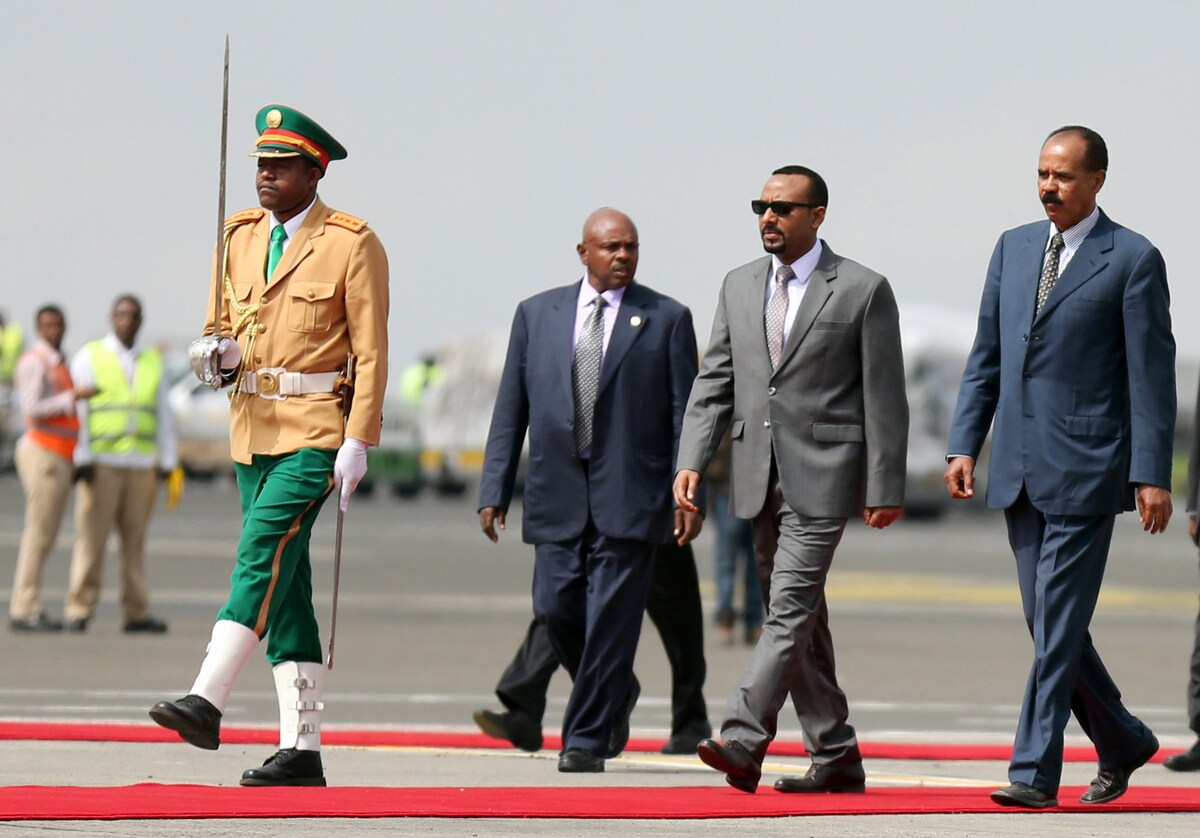

The relationship between Ethiopia and Eritrea, once hailed as a beacon of hope for peace in the Horn of Africa, is now teetering on the edge of conflict again. The promise of a lasting reconciliation that emerged after the 2018 peace agreement has gradually given way to renewed tensions, leaving the region on tenterhooks. Despite the optimism that followed Abiy Ahmed’s rise to the Ethiopian premiership and the subsequent Nobel Peace Prize, the following years have brought growing signs of discord. The recent developments in November and December 2024 suggest that the two countries may be headed toward a dangerous brink once again.
From Historic Peace to Growing Suspicion
In 2018, Ethiopian Prime Minister Abiy Ahmed’s decision to end the “no peace, no war” standoff with Eritrea, signed by both governments, was hailed as a historic breakthrough. After two decades of armed conflict, the peace agreement appeared to lay the foundation for stronger bilateral relations, economic cooperation, and regional stability. However, the promise of lasting peace was marred by the underlying complexities that were left unaddressed. By 2022, tensions began to rise, although neither Ethiopia nor Eritrea officially acknowledged the reasons behind the sudden shift.
While no direct cause has been formally cited, analysts suggest that the deterioration of relations is closely tied to the aftermath of the Tigray conflict. The war between the Tigray People’s Liberation Front (TPLF) and the Ethiopian government, which began in November 2020, exacerbated these tensions. Eritrea’s military involvement in the war, fighting alongside Ethiopia against the TPLF, is believed to have been a response to rocket attacks from the TPLF targeting Eritrean cities, particularly Asmara. Although Ethiopia and Eritrea initially united in their military efforts, the conclusion of the war with the signing of the Pretoria Agreement in November 2024 has cast a long shadow over the two nations’ bilateral ties.
The Roots of Tigray Conflict and Eritrea’s Involvement
The Tigray conflict itself was ignited by an unexpected attack from the TPLF on the Ethiopian Northern Command in early November 2020. This action caught Ethiopia by surprise, particularly since Tigray forces had been stationed along the northern border for decades. The attack, which resulted in significant casualties, set off a chain of events that spiraled into a violent war involving multiple factions, including Eritrea, which had been initially involved as a strategic ally of the Ethiopian government.
The TPLF, having lost its central government influence after Meles Zenawi’s death, was seeking to reassert itself, claiming that the Ethiopian federal system, based on ethnic federalism, posed an existential threat to the Tigray region. The TPLF’s leadership framed its military actions as a defensive maneuver against what it described as a “siege” by enemy forces, including the Ethiopian government, Eritrea, and Amhara militias. The conflict quickly escalated, resulting in significant civilian casualties, with estimates suggesting that as many as one million lives were lost during the two-year-long war.
In the aftermath, the Eritrean government, led by President Isaias Afewerki, has remained tight-lipped about its own losses, despite its active participation in the conflict alongside Ethiopian forces. While the relationship between Ethiopia and Eritrea appeared to have been strengthened by their shared military objectives, the end of the war has seen both countries returning to a state of tension and uncertainty.
Diplomatic Fallout: Tensions Erupt in Public
In late 2024, the deteriorating relationship between Ethiopia and Eritrea became more apparent through a series of public confrontations. On November 30, 2024, Eritrean President Isaias Afewerki gave an extensive interview on state-run Eri TV, during which he harshly criticized Ethiopia’s political structure. Afewerki voiced concerns about Ethiopia’s ethnic-based federal system, which he argued was the root cause of instability in the region. He warned that Ethiopia’s ethnic divisions could spill over into neighboring countries, including Eritrea, posing a significant regional security threat.
Afewerki’s remarks were not entirely new; he has repeatedly criticized Ethiopia’s political system in the past. However, the tone and substance of his comments seemed to take an even sharper edge, which did not go unnoticed by the Ethiopian government. In a highly unusual response, the Ethiopian government took to its own state media, Fana Broadcasting, on December 9, 2024, to issue a pointed rebuttal. The eight-minute broadcast accused President Afewerki of “ignoring his own country’s problems” and highlighting Ethiopia’s constitutional flaws while ignoring Eritrea’s own lack of a written constitution and its failure to hold elections since gaining independence. The Ethiopian government’s sharp words suggested that these remarks were not simply the views of the media but an official statement reflecting the prime minister’s office’s position.
Economic Strain and Diplomatic Deadlock
The diplomatic fallout between the two countries has not been limited to media exchanges. Economic and logistical ties, which had been seen as a potential avenue for peace and cooperation, have also frayed. Ethiopian Airlines, which had resumed flights to Eritrea after the peace agreement, suspended its operations to Asmara in late 2024. The airline cited increasingly difficult operational conditions in Eritrea as the reason for the suspension. In retaliation, the Eritrean government filed a lawsuit against Ethiopian Airlines for over $3 million in compensation for the “loss of passengers’ luggage.”
Moreover, reports have emerged that the phone lines connecting Ethiopia and Eritrea have been cut off, further severing communication between the two governments. In Ethiopia, there have been allegations of police harassment and arbitrary detention of Eritrean migrants, which the Ethiopian government has denied. These developments paint a picture of growing animosity and distrust between the two nations, with little hope for meaningful dialogue in the near future.
Regional Implications and the Risk of Escalation
The deterioration in Ethiopia-Eritrea relations is not occurring in a vacuum. Eritrea, which has always played a central role in the regional geopolitics of the Horn of Africa, is now deepening its ties with other regional players, notably Egypt and Somalia. In October 2024, Eritrea, Egypt, and Somalia signed a tripartite agreement in Asmara, marking the strengthening of alliances that could have significant consequences for regional stability.
At the same time, Eritrea is believed to have rekindled its alliance with the TPLF faction, now under the leadership of Debretsion Gebremichael. Reports suggest that the TPLF, which had been a formidable force in Ethiopia’s northern regions, is once again preparing for military action. There are concerns that this renewed alliance between Eritrea and the TPLF could escalate into a new round of hostilities, potentially destabilizing the entire Horn of Africa.
A Path Forward: Can Diplomacy Prevail?
The outlook for Ethiopia and Eritrea remains uncertain. While the international community, including the African Union and other regional bodies, has played a role in mediating past conflicts between the two nations, there seems to be little will for formal negotiations at this stage. Without proactive efforts from both governments to de-escalate tensions, the region risks slipping back into conflict, with dire consequences for millions of civilians caught in the crossfire.
For Ethiopia and Eritrea, the challenge now lies in managing their longstanding grievances and political differences. The path to peace will require more than just avoiding military conflict; it will demand a renewed commitment to dialogue, regional cooperation, and addressing the underlying issues that have long plagued both countries. If these tensions are left unchecked, the Horn of Africa may once again face the threat of war, with all the catastrophic human and economic costs that it would entail.


