
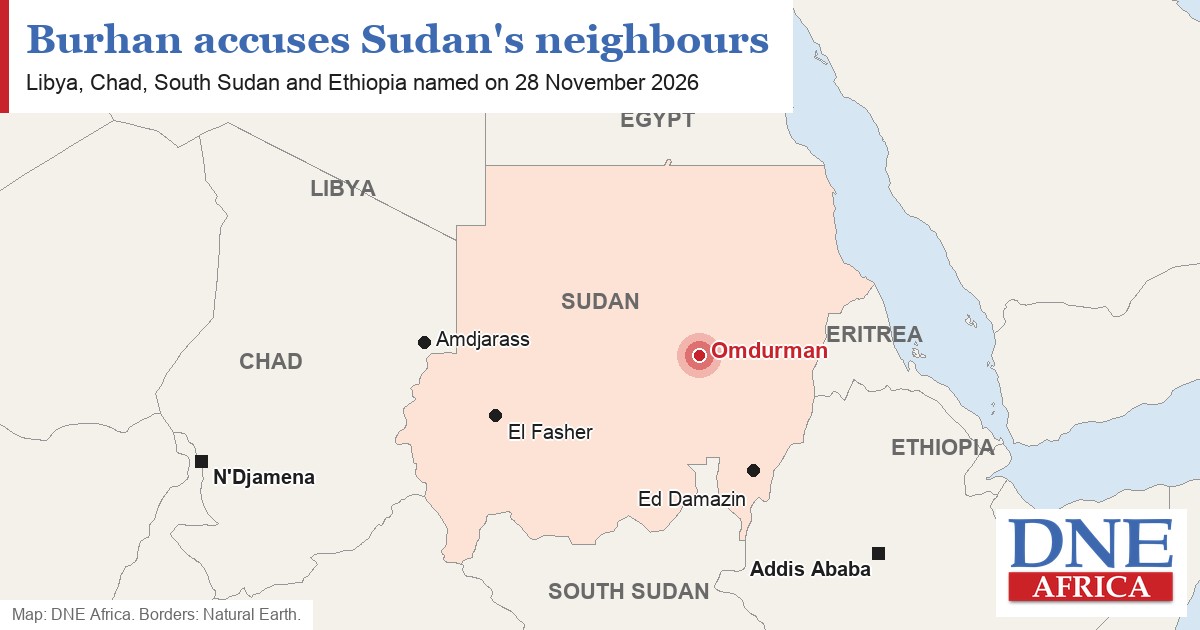

Sudan’s army chief Abdel Fattah al-Burhan said on Saturday that most of Sudan’s neighbours had joined the war against his country, naming Libya, Chad, South Sudan and Ethiopia as launch pads for attacks by the Rapid Support Forces (RSF) militia.
The accusation, made at a ceremony in Omdurman, widens the list of states Khartoum blames for sustaining the war between Sudan’s army and the RSF militia, and comes as Sudan’s relations with Chad and Ethiopia are already strained by border incidents and drone strikes. None of the four had responded by Saturday evening.
What did Burhan say about Sudan’s neighbours?
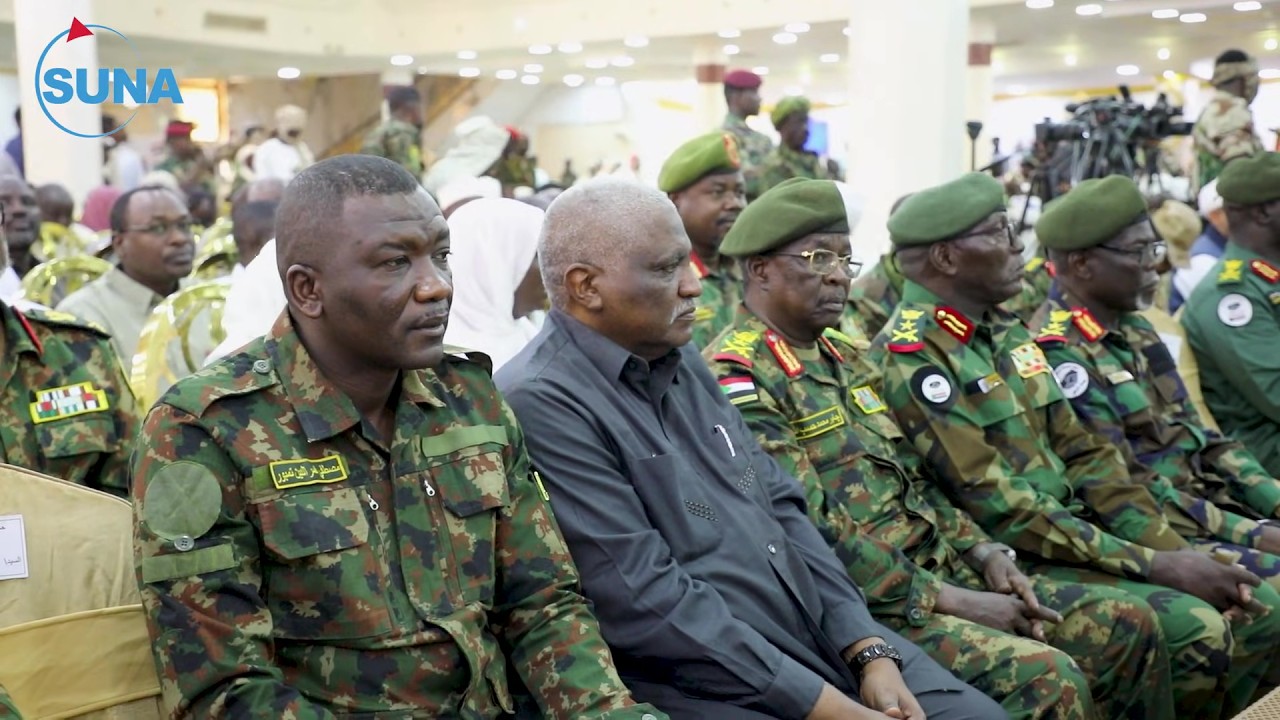
Gen Burhan, who chairs the Transitional Sovereignty Council and commands the armed forces, spoke at a ceremony honouring wounded fighters of the Joint Forces, the Darfur armed movements fighting alongside the army, organised by Darfur governor Minni Minawi.
“Most of the neighbouring countries have been turned into enemies. They paid them money to fight us,” he said, in remarks shown in a video of the speech posted on YouTube. “Now the enemy sets out from Ethiopia, the enemy sets out from Chad, from South Sudan, from many of the countries around us. It sets out from Libya to strike Sudan.”
“Anyone who has touched Sudan will pay the price,” he added, saying that would happen “sooner or later”.
He said countries “that have money” had bought fighters to kill Sudanese people and warned that the same model could later be turned on Sudan’s neighbours too. He did not name those countries in the speech.
Will the army stop fighting the RSF militia?
Gen Burhan repeated that the army would not lay down its weapons until the RSF militia was defeated “once and for all”, and ruled out talks with it. “Our enemy is the Rapid Support militia and everyone who supported this militia,” he said, adding that the fight was not against any tribe or race.
He told the wounded fighters that the Joint Forces was an operational name only and that its members were soldiers of the Sudanese army. He said he hoped the next celebrations would be held in Darfur, in El Fasher, El Geneina and Zalingei.
He also pledged $5mn for a fund for wounded Joint Forces fighters, to be handed over at once, Sudan Tribune reported.
What have Sudan’s neighbours said about the accusations?
The claims could not be independently verified, and Sudan’s neighbours have rejected similar accusations before. Sudan complained to the UN Security Council in 2024 that the United Arab Emirates was arming the RSF militia with help from Chad, which the UAE called baseless.
Chad’s then foreign minister Abderaman Koulamallah said in 2024 that his country had “no interest in amplifying the war in Sudan by supplying weapons”. In May this year, Ethiopia’s foreign ministry called Sudanese claims that drones had been launched from its territory “baseless” and accused Sudan’s army of backing Tigrayan fighters. South Sudan’s government has said it is neutral in the war.
UN investigators have described some of the routes. The UN fact-finding mission for Sudan said in September that recruiters and suppliers operating from Colombia and the UAE used transit points in Chad, south-eastern Libya and Bosaso in Somalia to support the RSF militia. The UN Panel of Experts on Libya said in April that a battalion of Khalifa Haftar’s eastern-based forces helped move fighters, weapons and fuel from the Kufra area to the militia, Africanews reported. The UAE has denied arming the militia.
Sudan’s government rejected an Ethiopian offer to host Sudanese talks this week, saying Addis Ababa was not neutral, as DNE Africa reported on Wednesday. The army has also been fighting the RSF militia in Blue Nile near the Ethiopian border, where it said on Friday it had retaken Khor Maganza.
What happens next?
Gen Burhan’s warning to Sudan’s neighbours leaves little room for the truce that mediators are pressing for. In Switzerland on Saturday, Sudanese political and civil groups ended the seventh round of the informal “Nyon process”, held from 25 to 28 November by the mediation group Promediation with support from the Swiss foreign ministry. In a closing statement, participants called for a truce leading to a lasting ceasefire, a link between the security track backed by the Quad and the political track backed by the Quintet, and the rejection of any partition of Sudan.
For background on the parties and the stakes, see DNE Africa’s Sudan war explainer.
FAQ
Which of Sudan’s neighbours did Burhan name?
Gen Burhan said the RSF militia was attacking Sudan from Libya, Chad, South Sudan and Ethiopia, in a speech in Omdurman on 28 November 2026.
Have Sudan’s neighbours denied supporting the RSF militia?
Of Sudan’s neighbours, Chad and Ethiopia have rejected earlier accusations, South Sudan says it is neutral, and the UAE denies arming the militia. None had responded to Saturday’s remarks by the evening.
What are the Joint Forces in Sudan?
They are Darfur armed movements, including Minni Minawi’s, that fight alongside Sudan’s army. Gen Burhan pledged $5mn for their wounded fighters.
Is there a ceasefire in Sudan?
No. Gen Burhan said the army would keep fighting until the RSF militia is defeated, while Sudanese civilian groups meeting in Switzerland called for a truce.


