
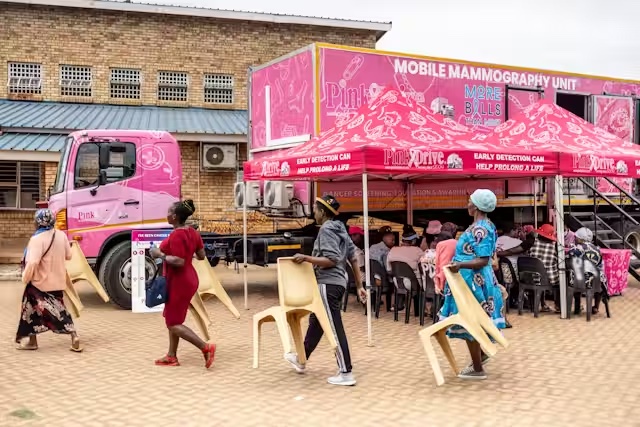

There are many myths about breast cancer, particularly in Africa with its rich diversity of people, different genetic backgrounds and ancestral histories.
An advertising campaign from the US, for example, asserts that 1 in every 8 women will develop breast cancer during their lifetime.
This statistic has pervaded the rest of the world, where it is accepted as fact. But in sub-Saharan Africa, the lifetime risk of a woman developing breast cancer is much lower. In South Africa, for example, the lifetime risk of a black woman developing breast cancer is 1 in 43.
Breast cancer is still one of the most prevalent cancers in this region, however, and is associated with high mortality because of socio-economic factors that prevent early diagnosis and access to treatment.
As researchers investigating diseases in populations of African ancestry, we aim to use scientific research to directly benefit patients.
Here, we highlight four misconceptions facing women with breast cancer in Africa. Dispelling these myths is important so that breast cancer care can focus on the dire socio-economic issues facing patients.
Myth: Breast cancer is a single disease
In reality, breast cancer has many different forms, based on the expression of proteins on the surface of the tumour cell called receptors.
• Hormone receptor-positive breast cancers have receptors that use hormones, oestrogen or progesterone, to help them grow.
• HER2-positive breast cancers use the human epidermal growth factor receptor 2 to promote growth. (HER2 is a protein involved in normal cell growth.)
• Triple-negative breast cancer refers to cancer cells that do not have oestrogen, progesterone or HER2 receptors. These cancers tend to grow and spread faster than other cancers.
Knowing what type of breast cancer you have is important to determine the treatment you can receive, how likely you are to overcome the cancer, and how likely it is to recur.
Myth: Cancer in one part of Africa is the same as another
It is commonly believed that African women who develop breast cancer have highly aggressive cancers, such as triple negative breast cancer.
Because of the diversity at both a regional and an individual level, there are differences in the distribution of the different types of breast cancer. A review of 63 studies from 24 different African countries found that triple negative breast cancers were most likely to be found in patients from west Africa.
Women from east and southern Africa were more likely to have hormone receptor-positive breast cancers. Our research, along with other studies, has shown that in South Africa, women of African ancestry are more likely to have hormone receptor-positive tumours, with or without HER2, types with a better prognosis. In a study of over 1,000 breast cancer patients (black women) in Johannesburg, 55% had hormone receptor-positive cancers, 27% had HER2 disease and 14% were triple negative breast cancers.
This diversity is further highlighted when we use genomic assays to examine tumours at a molecular level. This testing method examines tumour tissue at a gene level, providing a more fine-tuned typing of the cancer. It is used to aid in optimising treatment plans, and to predict how likely it is that a cancer will recur.
Myth: Breast cancer can’t be treated
This myth is still prevalent among some groups in Africa.
In fact, both hormone receptor-positive cancers and those with HER2 have well-established treatment options in addition to surgery, chemotherapy and radiation. These cancers have good survival rates, especially if diagnosed early.
Triple negative breast cancer treatment options are more limited, comprising surgery, chemotherapy and radiation.
More recently, a better understanding of triple negative disease has led to the development of new therapies to target the biology of this cancer.
Examples are immunotherapy, which enhances a patient’s own immune system to recognise cancerous cells and eliminate them, and PARP inhibitors, targeted drugs that block the enzyme (PARP) that tumour cells use to repair damaged DNA, resulting in the cell dying.
However, the sad reality is that socio-economic factors mean that these new generation therapies are mostly beyond the reach of patients.
Myth: HIV causes breast cancer
While HIV and other viral infections have been linked with the development of some other cancers, this is not the case for breast cancer. The relationship between HIV infection and breast cancer is complex.
There is little difference in survival and recurrence rates when HIV-positive patients have hormone receptor-negative tumours. Yet, HIV-positive patients with hormone receptor-positive cancers have worse outcomes, even though on their own, hormone receptor-positive cancers have a better prognosis.
Removing the stigma around breast cancer and HIV can help women to seek treatment earlier.
Ways to beat breast cancer in Africa
It’s important to dispel myths and empower women with knowledge and understanding about breast cancer.
But the reality is that obstacles still exist for breast cancer patients.
The biggest challenge is overcoming the socio-economic problems plaguing this continent.
Early detection is critical for improved survival and there should be greater focus on breast cancer awareness. Screening programmes need to be expanded effectively into low resource settings.
Training of primary healthcare workers to perform clinical breast exams on all women would detect abnormalities earlier. After that, patients should be given assistance to find their way around the complex healthcare systems so that they can get treatment in good time.
Finally, we call for more patient-focused research to better understand the burden of disease, the pathways to improved care, and how to tailor therapies for our unique population to achieve the best outcomes.
Raquel AB Duarte, Associate Professor; Head of Translational Research, University of the Witwatersrand; Caroline Dickens, Researcher, University of the Witwatersrand, and Therese Dix-Peek, Associate researcher, Internal Medicine, University of the Witwatersrand
This article is republished from The Conversation under a Creative Commons license. Read the original article.


