
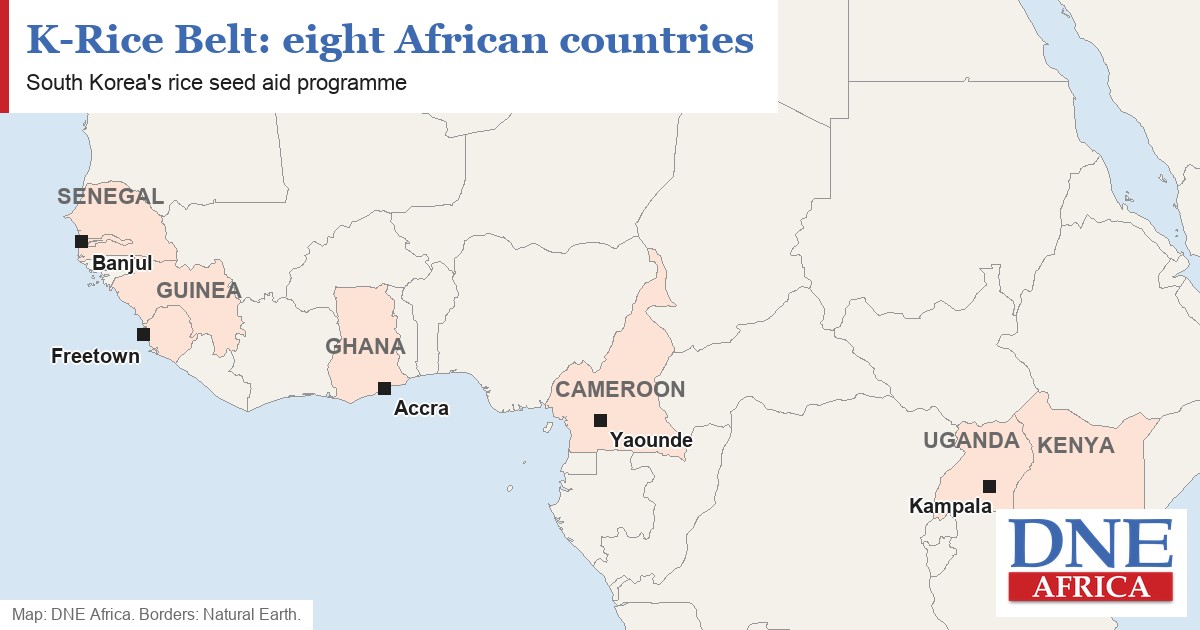

South Korea’s K-Rice Belt programme has more than doubled average rice yields on participating farms in Africa, from 2.2 tonnes a hectare to 4.6 tonnes, the head of the country’s Rural Development Administration said in Seoul on Friday.
The claim, made at the first joint review of the aid programme by three Korean agencies, comes as Seoul prepares to open seed production complexes in the eight African countries from next year, starting with Ghana.
What did Korea say about the K-Rice Belt’s results?
Lee Seung-don, administrator of the Rural Development Administration (RDA), told a meeting on the K-Rice Belt’s results at a hotel in central Seoul that average productivity on participating farms had risen from 2.2 tonnes a hectare under local practices to 4.6 tonnes, according to Yonhap, South Korea’s news agency.
“What is more meaningful is that the results have gone beyond simple technology transfer and led to self-reliance,” Lee said. In Uganda, where the government is preparing a food reserves bill as 3.6mn people face hunger, he said local farmers’ co-operatives now produce and distribute seed themselves and that competition between farmers had pushed the best yield to 9.6 tonnes a hectare.
The figures are the RDA’s own and could not be independently verified. The agency did not say how many farms or hectares they cover, or over which seasons the yields were measured.
How does the K-Rice Belt work?
The K-Rice Belt is South Korea’s flagship agricultural official development assistance (ODA) programme in Africa. It aims to raise rice self-sufficiency in major rice-consuming African countries by producing and distributing high-yield seed varieties suited to each country and helping build stable production, Yonhap said.
It started in Ghana in 2023, expanded in 2024 to Gambia, Guinea, Senegal, Uganda, Cameroon and Kenya, and added Sierra Leone this year, making eight countries in all.
The work is split between three bodies: the Ministry of Agriculture, Food and Rural Affairs sets policy, the RDA produces seed and trains farmers, and the Korea Rural Community Corporation builds seed production infrastructure.
What comes next for the K-Rice Belt?
Park Sang-ho, the agriculture ministry’s director for international agricultural cooperation, said seed production complexes would be completed one after another from next year, starting in Ghana, making stable seed supply possible. The ministry would also work more with private companies and international organisations, not only the recipient governments, he said.
Experts at the meeting, chaired by former vice-minister Lee Myung-soo, called for the K-Rice Belt to grow into Korea’s leading agricultural aid programme, with more co-operation with civil society, companies and international bodies, more young farmers, and value chains built around markets and consumers. The event was part of the government’s 2026 Development Cooperation Week.
Why does rice matter to Africa?
Rice consumption has grown fast across West and East Africa as cities expand, and many countries in the K-Rice Belt, including Senegal, Ghana and Kenya, rely heavily on imports, mainly from Asia, to meet demand. Higher local yields would reduce import bills and exposure to swings in world prices, which spiked when India restricted rice exports in 2023.
Other governments are also trying to cut farm import bills; Algeria says its fertiliser imports will end by 2028. South Korea has made agriculture a pillar of its Africa policy since the Korea-Africa summit in Seoul in June 2024, where the K-Rice Belt was among the projects promoted. Other Asian donors, including Japan through its long-running Coalition for African Rice Development, also back African rice production.
FAQ
Which countries are in the K-Rice Belt?
Ghana, Gambia, Guinea, Senegal, Uganda, Cameroon, Kenya and Sierra Leone.
What yields does Korea claim for the K-Rice Belt?
The Rural Development Administration says participating farms average 4.6 tonnes a hectare, against 2.2 tonnes under local practices, with a best of 9.6 tonnes in Uganda.
When did the programme start?
In Ghana in 2023. Six more countries joined in 2024 and Sierra Leone in 2026.
What happens next?
Seed production complexes are due to be completed from 2027, starting in Ghana, Korea’s agriculture ministry said.


