
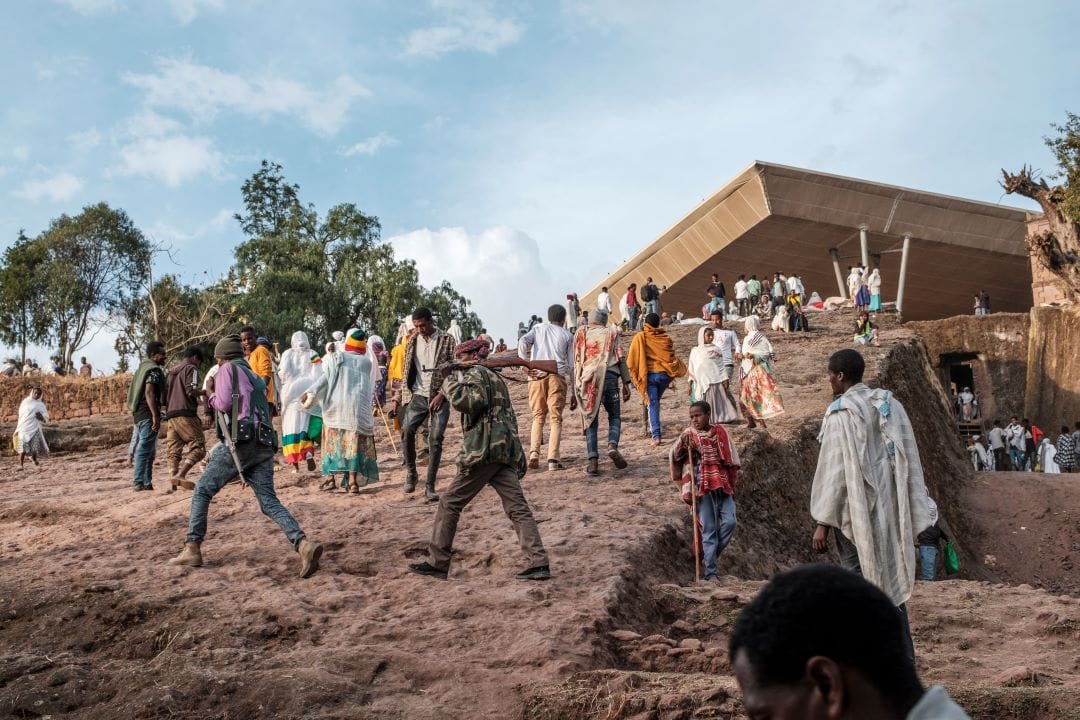

A series of government-backed rallies, initially organized to show support for Ethiopia’s ongoing military operations in the Amhara region, descended into chaos on Wednesday as grenade attacks and protests erupted across multiple cities. The demonstrations, which were supposed to rally public support for the government’s crackdown on the Fano militia, instead sparked violent confrontations, forcing many participants to shift their allegiance toward the Fano forces.
The rallies, which were reportedly coerced by the government, were meant to rally support for Prime Minister Abiy Ahmed’s administration and denounce the Fano militia, a regional armed group that has clashed with government forces for years. According to the Ethiopian Media Service (EMS), an independent media outlet with sources in the region, government officials pressured local residents—especially those receiving government welfare benefits, such as those under the Safetynet program or residing in government-subsidized housing—to attend these rallies. Residents were allegedly told that failure to attend would result in the loss of their benefits, creating a climate of fear and compliance.
The government had hoped these rallies would reinforce its narrative of law enforcement efforts aimed at quelling unrest in the region. However, the response was not what the government had anticipated. As the rallies unfolded, violent attacks, including grenade explosions, disrupted the events, highlighting the intensifying opposition to the government’s military operation in the region. What started as pro-government demonstrations soon turned into anti-government protests, with chants supporting the Fano militia and criticizing Prime Minister Abiy Ahmed’s leadership.
Government-Backed Rallies Face Widespread Resistance
The rallies were held in major cities such as Bahir Dar, Debre Markos, Dessie, Woldia, Gondar, and Debre Berhan. In these cities, federal government forces were deployed to oversee and manage the crowds. However, in many areas, the rallies were met with violent resistance from local Fano militias and their supporters, turning peaceful gatherings into intense confrontations.
In Bahir Dar, one of the region’s largest cities, grenade explosions were reported at six different locations, triggering panic and confusion. Local sources, including Yohannes Alemayehu, a spokesperson for the Fano forces in Gojjam, confirmed that at least four police officers were killed in a grenade attack on the city’s second police division. The violence escalated quickly, forcing the authorities to disperse the crowds.
Initially, participants in the rallies were coerced into chanting slogans that supported the government and its military actions. However, as the day progressed, the tide turned. In several locations, the crowds began to chant in favor of Zemene Kassie, a prominent leader of the Fano forces in Gojjam, instead of supporting the government. The shift in allegiance was swift and dramatic, leaving government officials and military forces scrambling to regain control. In response, rallies that were meant to display unity with the government were quickly dispersed after participants began to shout anti-government slogans.
Similar incidents of violence and disruption were reported in Woldia, Dessie, and other towns in the region. In some areas, the protests turned into full-blown confrontations between government forces and Fano militias. In Hayk, a town near Dessie, a pro-Fano rally was held despite the government’s crackdown. Reports indicated that government forces detained over 300 local youths in an attempt to suppress the demonstration. The arrest of such a large number of young people only fueled further resistance against the government.
Fano Forces and Their Growing Support
The rise of the Fano militia has been a significant development in the ongoing conflict in Ethiopia’s Amhara region. Initially formed as a militia to defend ethnic Amhara interests, Fano has grown into a formidable force that controls large swaths of territory, especially in rural and smaller towns. The group’s influence has been bolstered by strong grassroots support, particularly in the face of what many locals see as neglect and mistreatment by the federal government.
Fano’s growing control over the region poses a serious challenge to the government, which has launched multiple military operations aimed at neutralizing the militia. When the Ethiopian government initiated its military campaign in August 2024, officials claimed the operation would be completed within a few weeks. However, despite these promises, the Fano forces have continued to gain ground, and now control over 80% of the Amhara region. The group’s influence extends deep into rural areas, and the militia’s ranks are bolstered by an estimated 400,000 armed fighters. This has made it increasingly difficult for the Ethiopian government to impose its authority in the region.
The Fano militia’s ability to maintain such a large and committed fighting force has prevented the government from establishing full control over the Amhara region. The group’s leadership has managed to rally significant local support, particularly among ethnic Amharas who feel marginalized by the federal government’s policies. These policies, including land development programs and forced relocations, have further alienated local populations and fueled the anger of ethnic Amharas.
Displacement and Human Rights Violations
The Ethiopian government’s controversial policies, especially those targeting ethnic Amharas, have been at the heart of the growing unrest in the region. Since Prime Minister Abiy Ahmed took office in 2018, the Amhara people have experienced widespread violence, displacement, and discrimination. Tens of thousands of ethnic Amharas have been massacred in attacks by extremist groups such as “Shene,” a militant ethnic Oromo nationalist group, in regions such as Oromia and Benishangul-Gumuz. These killings, often attributed to factions within the Ethiopian government, have further fueled anger and resentment among the Amhara population.
In addition to the massacres, the Ethiopian government has been accused of displacing large numbers of ethnic Amharas from major cities like Addis Ababa. Under the guise of “corridor development” projects, thousands of ethnic Amharas have been forcibly removed from their homes, with many long-time residents being relocated to rural areas or pushed out of the capital entirely. Critics argue that these policies are politically motivated, aimed at reducing the influence of ethnic Amharas in key urban centers and weakening their support for the Fano militia.
Despite these accusations, the government continues to deny that there is an existential threat to ethnic Amharas. Instead, government officials, including Arega Kebede, President of the Amhara region, maintain that the government’s efforts are focused on restoring peace and promoting development in the region. Prime Minister Abiy Ahmed has publicly stated that his government is committed to ensuring the stability of the Amhara region, but his efforts have been met with skepticism by both local activists and international observers.
Peace Efforts and the Continued Fight for Justice
While the Ethiopian government has called for peace talks and urged the Fano forces to disarm, many local activists, opposition politicians, and Fano leaders have dismissed these peace initiatives as disingenuous. Zemene Kassie, a prominent Fano leader in Gojjam, has expressed confidence in the Fano forces’ ability to continue their fight, stating, “It is proof that we have won,” in reference to the widespread disruption of government-backed rallies in the region.
Critics argue that Prime Minister Abiy Ahmed is more interested in consolidating his political power than in reaching a fair and sustainable peace agreement. Despite receiving significant financial support from the International Monetary Fund (IMF) and the World Bank for economic reforms, critics contend that these reforms are being driven by external pressure and are not a genuine reflection of the needs and demands of the Ethiopian people.
As the situation in the Amhara region continues to deteriorate, the future of Ethiopia’s stability remains uncertain. With Fano forces growing stronger and the government struggling to regain control, it is unclear whether peace can be restored to this deeply divided region. The government’s failure to address the grievances of the Amhara people may ultimately lead to a further escalation of violence and a prolonged struggle for justice.
The Way Forward
The conflict in the Amhara region is a complex issue that involves deep ethnic tensions, government policies, and the resilience of local militias like the Fano. Until a more inclusive peace process is put in place, it seems unlikely that the violence will subside. With the Fano militia now firmly entrenched in much of the region and with grassroots support continuing to grow, the Ethiopian government faces an uphill battle in its efforts to resolve the conflict and restore peace.


