

About 65% of Zimbabweans say citizens should always pay their taxes, but 52% believe some revenue is lost to corruption, a Zimbabwe tax survey by Afrobarometer released in Harare on 26 November found.
The findings come a week after Finance Minister Mthuli Ncube presented a 2027 budget that cuts income and transaction taxes, and as the Treasury seeks to widen the tax base.
What did the Zimbabwe tax survey find?
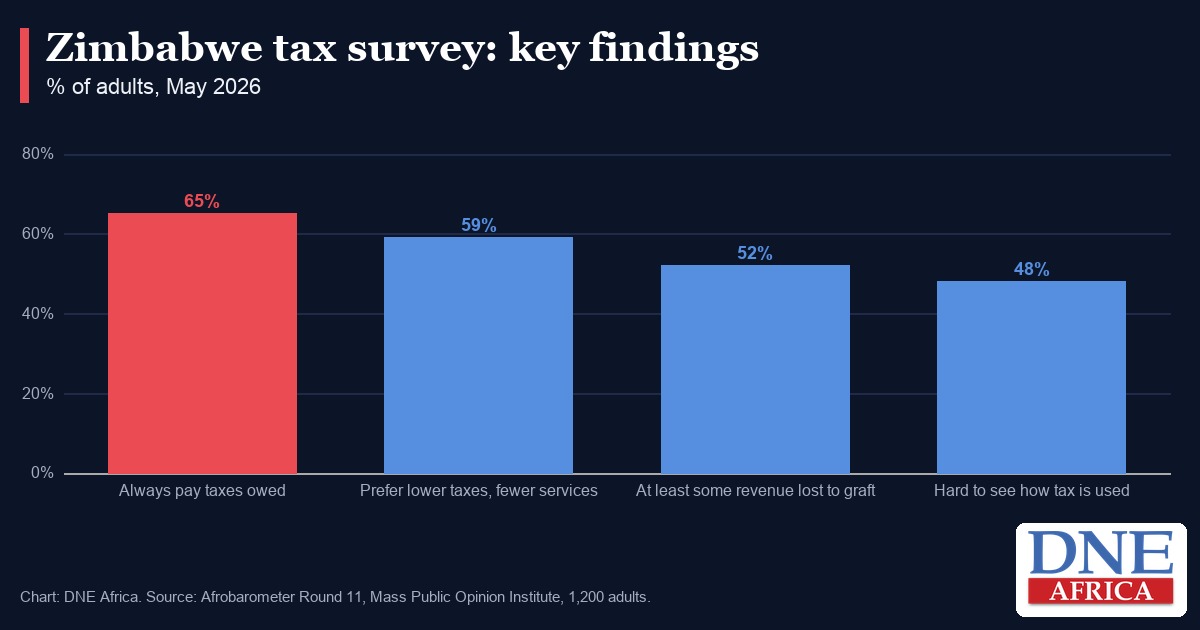
According to the Afrobarometer news release, 65% of respondents agreed that citizens should always pay direct taxes such as income, business or property taxes, even if they oppose the government and its actions. About 26% disagreed.
At the same time, the Zimbabwe tax survey found that 59% said it would be better for everyone if Zimbabweans paid lower taxes, even if that meant fewer government services. That is slightly more than in 2021, when 56% said they would prefer lower taxes and fewer services.
The survey was conducted by the Mass Public Opinion Institute (MPOI), Afrobarometer’s partner in Zimbabwe, which interviewed a nationally representative sample of 1,200 adults face to face in May 2026. The margin of error is plus or minus 3 percentage points at a 95% confidence level.
Do Zimbabweans think tax money is lost to corruption?
More than half of those polled, 52%, said at least “some” tax revenue collected by the government is lost to corruption. Only 5% said none is lost, and 34% said they did not know.
The Zimbabwe tax survey also asked how easy it is to find out how the government uses tax revenue. Almost half, 48%, said it was difficult or very difficult, while 26% were unsure or gave no answer. In a 2021 Afrobarometer dispatch, 69% had said this was difficult.
Views differ by region and education. Reports of difficulty rise with schooling and are nearly twice as high in Manicaland (60%) as in Masvingo (32%), Afrobarometer said.
What is the government doing on tax?
In his 2027 budget statement to Parliament on 19 November, Ncube proposed raising the monthly tax-free income threshold from $100 to $150 from 1 January 2027, with tax bands adjusted. He also proposed cutting the Intermediated Money Transfer Tax on ZiG transactions from 1.5% to 1.25% and on foreign-currency transfers from 2% to 1.75%, saying the measures would give “relief to citizens and companies”.
The minister said the budget introduced no new taxes. It projects revenue of ZiG349.5bn (about $12.5bn), or 18.1% of GDP, against total spending of ZiG358.3bn. The 2026 budget had raised value-added tax by half a percentage point to 15.5%. DNE Africa reported earlier on the 2027 plan to cut duty on mobile phones to zero.
The government has not commented on the Zimbabwe tax survey. The Treasury’s 2027 budget strategy paper says it plans to widen the tax base and modernise tax administration, including bringing more of the informal sector into the system. Recent DNE Africa coverage of Zimbabwe’s economic policy includes the division of ministerial powers between Ncube and Kudakwashe Tagwirei.
How does this compare with earlier surveys?
Afrobarometer has polled Zimbabwe since 1999. Its 2021 survey found that 75% agreed tax authorities always have the right to make people pay taxes, and 58% said ordinary people pay too much. The new Zimbabwe tax survey suggests that support for paying tax has held up, while doubts about how the money is used remain.
FAQ
What does the Zimbabwe tax survey show?
Afrobarometer found that 65% of Zimbabweans say citizens should always pay taxes they owe, while 52% believe at least some tax revenue is lost to corruption.
Who conducted the Zimbabwe tax survey?
The Mass Public Opinion Institute, Afrobarometer’s Zimbabwe partner, interviewed 1,200 adults in May 2026. The results were released on 26 November.
Do Zimbabweans want lower taxes?
Yes. About 59% said it is better for everyone if Zimbabweans pay lower taxes, even if it means fewer government services.
What tax changes are planned for 2027?
Finance Minister Mthuli Ncube proposed raising the monthly tax-free threshold to $150 and cutting the Intermediated Money Transfer Tax, with no new taxes.


