

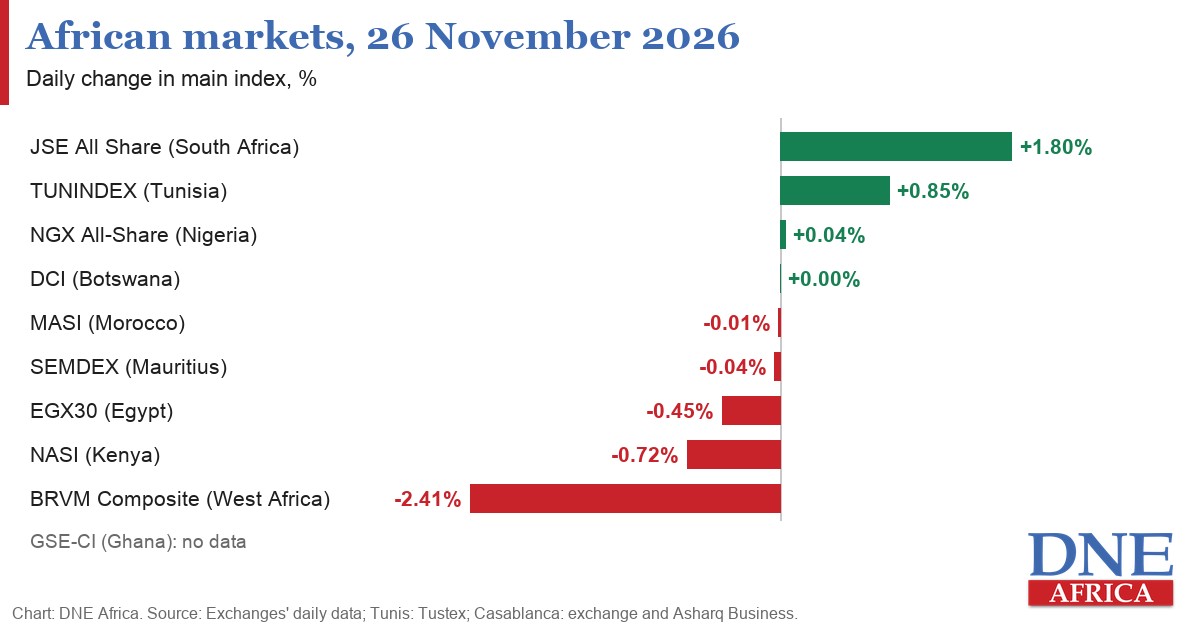
African stock markets were split on Thursday 26 November as Johannesburg’s All Share index rebounded 1.80 per cent, led by gold and platinum miners, while West Africa’s BRVM fell 2.41 per cent for an eighth straight loss.
Among other African stock markets, Tunis rose 0.85 per cent and Lagos edged up, while Nairobi, Cairo and Mauritius slipped and Casablanca ended flat. Global equities rose as technology stocks recovered, with Germany’s DAX up 2.18 per cent and London’s FTSE 100 up 1.85 per cent in trading thinned by the US Thanksgiving holiday, according to Asharq Business. Brent crude rose 1.5 per cent and the rand, naira and birr firmed against the dollar.
Why did Johannesburg lead African stock markets higher?
The JSE All Share index, the largest of the African stock markets, rose 1,884 points to 106,632, recovering all of Wednesday’s 1.38 per cent loss, according to JSE data. The Top 40 index of the biggest companies also gained 1.80 per cent, to 98,596.
Miners that led Wednesday’s fall led the recovery. Pan African Resources rose 5.78 per cent, Northam Platinum 5.63 per cent, Sibanye-Stillwater 5.41 per cent, Thungela 5.35 per cent, Impala Platinum 5.04 per cent and Harmony 4.56 per cent. Gold Fields gained 3.37 per cent and AngloGold Ashanti 3.14 per cent. Tiger Brands, the food producer, jumped 10.91 per cent, the biggest gain among heavily traded shares, and Naspers rose 1.92 per cent.
How far has the BRVM fallen?
The Composite index of the BRVM, the regional exchange based in Abidjan, lost 11.21 points to 453.57, the steepest fall among African stock markets on the day, and the BRVM-30 fell 2.52 per cent to 219.33, according to the exchange’s data. It was the eighth consecutive decline, after falls of 3.32 per cent on Monday, 0.94 per cent on Tuesday and 1.54 per cent on Wednesday. The exchange has not published a reason.
Unilever Côte d’Ivoire fell 7.50 per cent, Orange Côte d’Ivoire 7.05 per cent and the brewer Solibra 6.87 per cent. NSIA Banque Côte d’Ivoire rose 7.50 per cent and BOA Mali 5.64 per cent. Trading was worth CFA2.05bn.
Which other African stock markets rose?
Tunis extended its rally. The TUNINDEX rose 0.85 per cent to 19,933.51, close to the 20,000 mark, on volume of 13.3mn dinars, according to the Tunisian financial site Tustex. BNA, the most traded stock, gained 0.97 per cent on volume of 3mn dinars, and Sotetel rose 3.57 per cent. The Central Bank of Tunisia has held its main rate at 7 per cent.
The Nigerian Exchange All-Share index rose 94.18 points, or 0.04 per cent, to 244,089.47. Turnover jumped to N102.99bn ($74.2mn) from N40.92bn on Wednesday, on 1.54bn shares in 29,326 deals, according to the exchange’s market snapshot.
In Gaborone, no domestic share changed price for a fourth day, leaving the Botswana Stock Exchange Domestic Company Index unchanged at 11,358.82.
How did African stock markets in Cairo, Nairobi and Casablanca trade?
In Cairo, the Egyptian Exchange EGX30 fell 226.88 points, or 0.45 per cent, to 50,311.78, leaving its gain since the start of the year at 20.28 per cent. Decliners outnumbered gainers 122 to 79, according to EGX data, and shares worth about LE6.45bn ($118mn) traded across rising, falling and unchanged stocks. Egyptian investors accounted for 81.32 per cent of trading and non-Arab foreign investors 17.26 per cent.
Nairobi’s All Share index fell 1.70 points, or 0.72 per cent, to 233.99, and the NSE 20 lost 22.79 points to 4,091.92, the Nairobi Securities Exchange said. Equity turnover rose to KSh912.9mn ($7.0mn) from KSh518.5mn.
The Casablanca Stock Exchange MASI slipped 0.80 points to 16,570.52, a change of less than 0.01 per cent, while the MASI 20 of the largest stocks rose 0.31 per cent. Trading fell to 135.9mn dirhams ($13.6mn) from 3.17bn dirhams on Wednesday. Auto Nejma rose 5.98 per cent and Marsa Maroc 3.57 per cent, while BMCI fell 3.53 per cent and Managem 3.20 per cent. The Stock Exchange of Mauritius SEMDEX eased 0.04 per cent to 2,257.88 on trading worth Rs128.5mn.
The Ghana Stock Exchange, alone among the ten African stock markets tracked here, had not published Thursday’s summary by the time of writing.
African stock markets at the close
| Exchange | Index | Close | Change % | Turnover |
|---|---|---|---|---|
| Johannesburg | JSE All Share | 106,632 | +1.80 | n/a |
| Casablanca | MASI | 16,570.52 | -0.01 | MAD135.9mn ($13.6mn) |
| Egypt | EGX30 | 50,311.78 | -0.45 | LE6.45bn ($118mn) |
| Nigeria | NGX All-Share | 244,089.47 | +0.04 | N102.99bn ($74.2mn) |
| BRVM | BRVM Composite | 453.57 | -2.41 | CFA2.05bn |
| Nairobi | NASI | 233.99 | -0.72 | KSh912.9mn ($7.0mn) |
| Mauritius | SEMDEX | 2,257.88 | -0.04 | Rs128.5mn |
| Ghana | GSE-CI | no data | no data | no data |
| Botswana | DCI | 11,358.82 | 0.00 | n/a |
| Tunis | TUNINDEX | 19,933.51 | +0.85 | TND13.3mn |
Turnover on African stock markets is as published by each exchange (Tunis: as reported by Tustex); dollar figures use the rates below. “n/a” means no confirmed figure. For the previous session, see Wednesday’s African stock markets report, and Tuesday’s report.
How did African currencies and commodities move?
Most African currencies firmed slightly against the dollar. The rand strengthened to R17.53 per dollar from R17.59 on the South African Reserve Bank‘s weighted average rate, and the naira firmed 0.31 per cent to N1,387.89 on the official market rate published by the Central Bank of Nigeria. The birr gained 0.42 per cent on the National Bank of Ethiopia’s indicative rate. The Egyptian pound eased about 0.26 per cent on the Central Bank of Egypt’s official rate, to LE54.77 buying and LE54.91 selling.
Brent crude rose 1.47 per cent to $96.00 a barrel, according to Asharq Business market data. Oil rose as traders weighed the possible impact of attacks in the Middle East on the recovery of crude exports from the region, ahead of an OPEC+ meeting on 2027 supply, Asharq Business reported. Comex gold rose 0.95 per cent to $3,598.50 an ounce. No reliable same-day prices were available for cocoa, coffee, wheat or copper, with US trading limited by the holiday.
| Currency or commodity | Rate or price | Change | Source |
|---|---|---|---|
| Egyptian pound | 54.77 buy / 54.91 sell per $ | +0.26% (weaker); market rate 54.82, +0.24% | CBE official; Asharq Business |
| Nigerian naira | 1,387.89 per $ | -0.31% (stronger) | CBN official market rate |
| South African rand | 17.53 per $ | -0.34% (stronger) | SARB weighted average, about 10.30am |
| Kenyan shilling | 130.06 per $ | +0.03% (little changed) | CBK daily rate |
| Ghanaian cedi | 11.83 per $ (mid) | -0.17% (stronger) | Bank of Ghana interbank rate |
| Moroccan dirham | 10.011 per $ | -0.05% (slightly stronger) | Bank Al-Maghrib reference rate |
| Ethiopian birr | 160.79 per $ | -0.42% (stronger) | NBE indicative rate |
| Tunisian dinar | 3.0729 per $ (25 Nov) | no data | BCT interbank average, latest published |
| CFA franc | 655.957 per euro (fixed peg) | no data per $ | BCEAO peg |
| Brent crude | $96.00 a barrel | +1.47% | Asharq Business |
| Gold (Comex) | $3,598.50 an ounce | +0.95% | Asharq Business |
| Cocoa | no data | no data | no reliable source |
| Arabica coffee | no data | no data | no reliable source |
| Wheat | no data | no data | no reliable source |
| Copper | no data | no data | no reliable source |
Brent and gold prices are as quoted by Asharq Business at about 16:55 GMT on 26 November, after most African stock markets had closed. Central bank rates are those published for 26 November, including by the Central Bank of Kenya, the Bank of Ghana, Bank Al-Maghrib and the National Bank of Ethiopia, against 25 November; the dinar rate is the Central Bank of Tunisia‘s latest published average.
FAQ
How did African stock markets perform on 26 November 2026?
They were split. Johannesburg’s All Share rose 1.80 per cent and Tunis 0.85 per cent, while the BRVM fell 2.41 per cent and Nairobi 0.72 per cent. Ghana had not published data.
Why did Johannesburg shares rise?
Gold and platinum miners, which led Wednesday’s fall, led the rebound, according to JSE data. Tiger Brands rose 10.91 per cent.
How did African currencies and commodities move?
The rand, naira, cedi and birr firmed slightly against the dollar on central bank rates, while the Egyptian pound eased 0.26 per cent. Brent crude rose 1.47 per cent and Comex gold 0.95 per cent.
How long has the BRVM been falling among African stock markets?
Thursday’s 2.41 per cent decline was the BRVM Composite’s eighth in a row, taking the index to 453.57. The exchange has not published a reason.


