
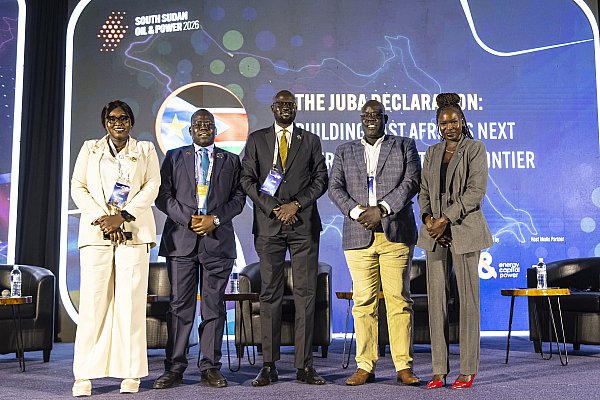

South Sudan Block B2 will get revised exploration terms, after which South Africa’s state oil company is expected to start drilling or assessment at once, the head of the Petroleum Authority said in Juba on Wednesday.
The frontier block is South Africa’s main upstream bet in South Sudan, and the government wants a working partner there to show other investors that its new licensing round is worth bidding for.
What is changing for South Sudan Block B2?
Eng. Lual Chol Dak, director general of the Petroleum Authority, said the exploration and production sharing agreement (EPSA) for the block would be revised and that the South African National Petroleum Company (SANPC) should then begin work immediately, according to a statement from Energy Capital & Power, which organised the South Sudan Oil & Power (SSOP) 2026 conference. “I want you to be the first investor to encourage the others,” he told SANPC’s delegation, the statement said.
The statement did not say which terms would change or when. SANPC, formed this year from PetroSA, iGas and the Strategic Fuel Fund, holds 90% of South Sudan Block B2 and the national oil company Nilepet 10%, according to South African trade press reports. The original agreement was signed in 2019, according to the South African government.
Why has South Sudan Block B2 been slow?
A geophysical survey of the block in Jonglei State was completed in 2024, but no drilling has taken place. The block covers most of Badingilo National Park and parts of the Sudd wetlands, SANPC acknowledged in a 2025 response to questions from South Africa’s Daily Maverick, which reported on the environmental concerns about the area, home to one of the world’s largest animal migrations.
Mr Dak said every upstream phase requires an environmental and social impact assessment, the organiser said.
What did operators commit to in Juba?
The closing session gathered commitments made during the two-day conference, the statement said. Dar Petroleum Operating Company accepted a petroleum ministry target of 120,000 barrels a day by August 2027, Sudd Petroleum Operating Company plans to reach 20,000 barrels a day in 2027, and Greater Pioneer Operating Company reported three hydrocarbon discoveries in 2026, according to the organiser.
Together, the targets support the government’s aim of lifting output above 200,000 barrels a day within two to three years. The caretaker petroleum minister set out that goal and a five-block licensing round at the conference’s opening; investors entering the round will be able to weigh the revised South Sudan Block B2 terms before they bid, the organiser said.
Mr Dak said EPSAs run for 25 to 37 years, subject to extension, and that pipeline, depot, refinery and laboratory projects were ready for negotiation. “We need real committed investors that can come and negotiate with us,” he said.
What do investors want from South Sudan?
Alam Chaat Paul of Stanbic Bank said simpler rules for moving money in and out of the country would make investment decisions easier, while a ministry planning official said the regulatory framework must stay competitive with those of Kenya, Uganda and Ethiopia, the statement said.
Oil provides most of South Sudan’s government revenue, and exports depend on a pipeline through Sudan that was disrupted in 2024 by the war between Sudan’s army and the RSF militia. Other deals at the conference included a heavy equipment distribution agreement.
FAQ
Who holds South Sudan Block B2?
South Africa’s state-owned SANPC holds 90% and South Sudan’s Nilepet 10%, according to South African trade press reports.
What will happen to the South Sudan Block B2 agreement?
The Petroleum Authority said the exploration and production sharing agreement will be revised, after which SANPC is expected to start drilling or assessment. No new terms or dates were given.
Where is the block?
In Jonglei State, in an area that includes most of Badingilo National Park and parts of the Sudd wetlands.


