

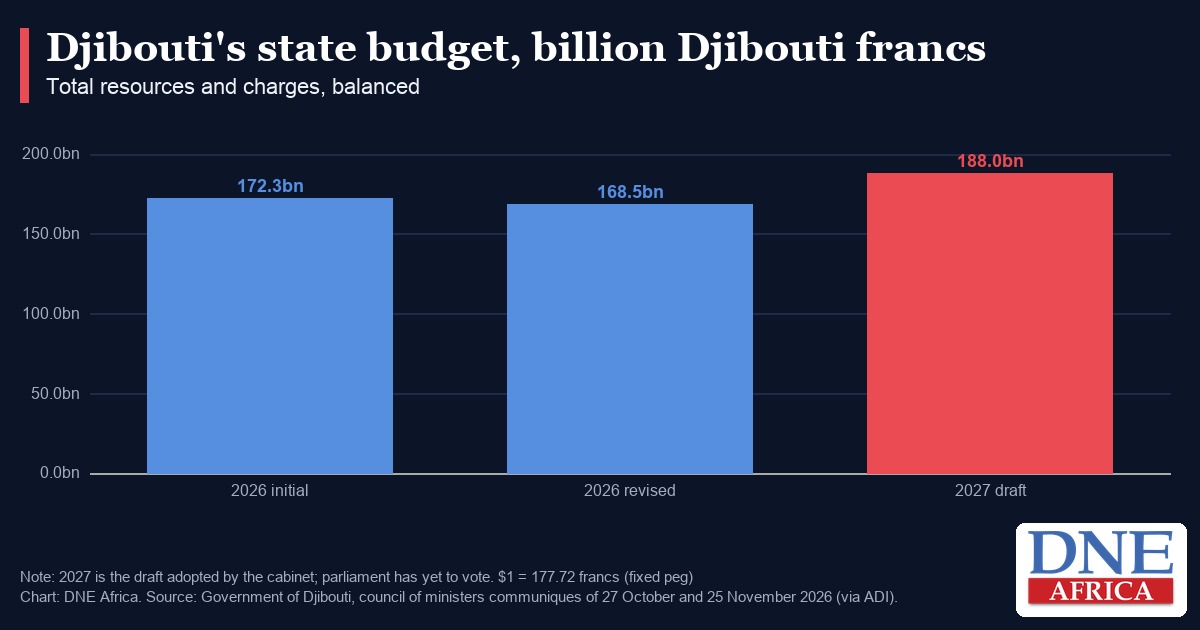
Djibouti’s cabinet has adopted a draft 2027 Djibouti budget of 188.02bn Djibouti francs ($1.06bn), up from 168.48bn in the revised 2026 budget, and plans to raise 10bn francs ($56mn) through sukuk, Islamic bonds.
The increase, 11.6 per cent on the revised 2026 figure and 9.1 per cent on the initial one, comes weeks after the government cut this year’s budget because revenue fell short. It puts more weight on investment and debt management at a time when the IMF has urged Djibouti to clear its arrears.
What is in the 2027 Djibouti budget?
President Ismail Omar Guelleh chaired the 15th session of the council of ministers on Wednesday, which adopted the draft finance law, according to the government communique published by the state news agency ADI (in French). The Djibouti budget is balanced, with resources and charges both set at 188,022,105,305 francs.
Current revenue is forecast at 163.21bn francs ($918mn), against 155.10bn in the revised 2026 budget, a rise of 5.2 per cent, the communique said. It includes 95.71bn francs of tax revenue, 54.55bn of other revenue and 12.95bn of grants, and makes up 86.8 per cent of total resources.
The state’s current and investment spending is set at 150.66bn francs: 110.39bn of current spending and about 40.27bn ($227mn) of investment. The communique did not detail the remaining charges. It said the government would keep control of the wage bill, rationalise running costs and give “particular attention” to public debt management and the clearing of arrears.
Why does the sukuk plan matter?
The 10bn-franc sukuk issue in the Djibouti budget is presented as a way to diversify the state’s financing instruments and mobilise extra resources. The communique gave no date, tenor or pricing for the issue.
The government said the budget implements the third national development plan, PND-ADEEG 2025-2030, in line with the Vision Djibouti 2035 strategy. The government said it also supports a move to performance-based budgeting, under a 2024-2027 public finance reform plan and an organic finance law now before parliament.
How did the 2026 Djibouti budget fare?
On 27 October the cabinet cut the 2026 budget to 168.48bn francs from 172.30bn, a reduction of 2.22 per cent. By the end of May, revenue including grants stood at 55.20bn francs, against a projection of 68.08bn, a gap of 12.88bn, while spending ran above plan, the government said then. It cited trade disruption, volatile energy and food prices and tight financing, and projected growth of 5.9 per cent in 2026, down from 6.5 per cent in 2025.
The IMF, in its 2025 Article IV review, said Djibouti had handled recent shocks well despite Red Sea tensions. Its staff projected public and publicly guaranteed debt at 67.2 per cent of GDP in 2025, falling to 56.9 per cent in 2027, and called on the government to “clear all arrears and finalize debt negotiations”.
Djibouti, whose ports handle most of Ethiopia’s trade, has been widening its partnerships in the region and this week signed three agreements with Madagascar.
What else did the cabinet decide?
The minister for women and the family told the council that cases of gender-based violence recorded in the national monitoring system rose 25 per cent, from 776 in 2024 to 971 in 2025. She attributed the rise mainly to better recording and care, and proposed a shelter for women and children who are victims of violence. Women and girls made up 93.8 per cent of recorded cases.
The cabinet also approved bills to ratify the Organisation of Islamic Cooperation’s Convention on the Rights of the Child in Islam and to accede to the Biological Weapons Convention.
The draft Djibouti budget now goes to the National Assembly, which must vote on it before the 2027 financial year begins.
FAQ
How big is the 2027 Djibouti budget?
The draft adopted by the cabinet totals 188.02bn Djibouti francs, about $1.06bn at the fixed rate of 177.72 francs to the dollar.
How does it compare with the 2026 Djibouti budget?
It is 11.6 per cent larger than the revised 2026 budget of 168.48bn francs, and 9.1 per cent larger than the initial 2026 budget of 172.30bn.
What is the sukuk plan in the Djibouti budget?
The government plans to raise 10bn francs through sukuk, Islamic bonds, to diversify its financing. No date or terms have been announced.
Is the budget final?
No. The cabinet adopted the draft finance law; the National Assembly still has to vote on it.


