
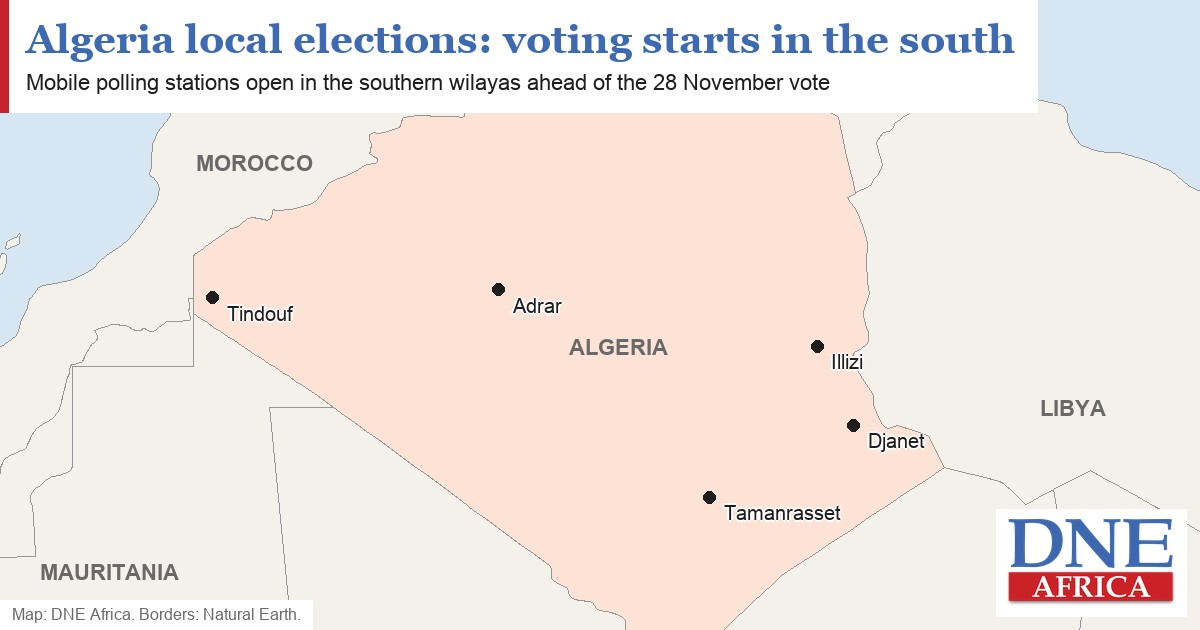

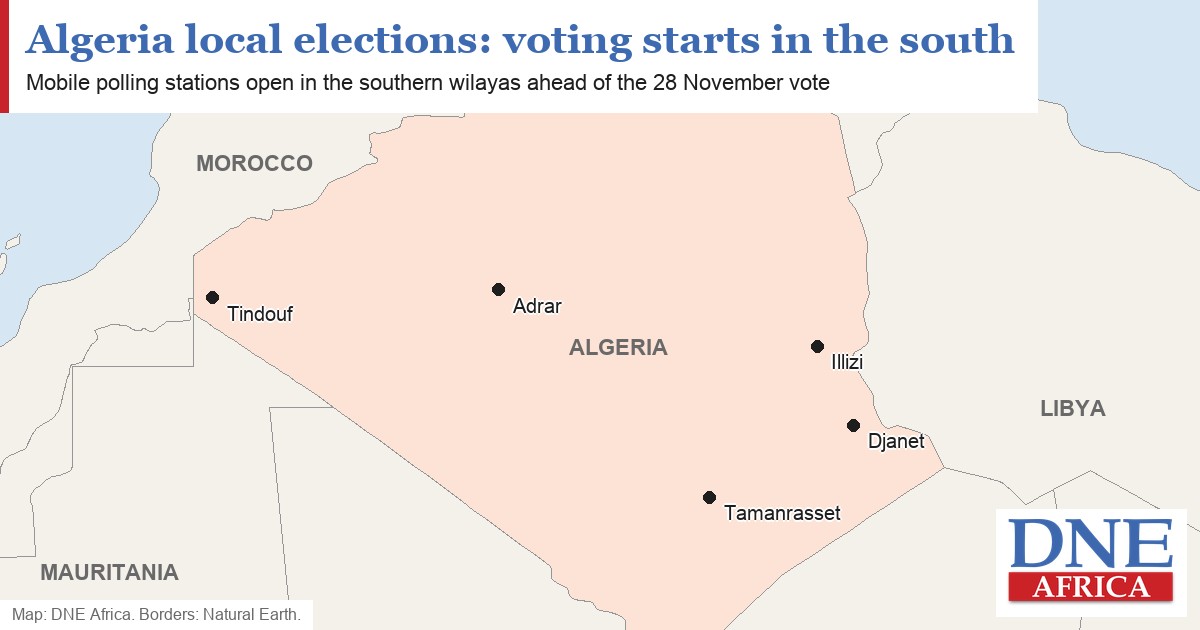
Voting in the Algeria local elections begins on Wednesday 25 November at mobile polling stations for nomadic and remote communities in the southern wilayas, three days before the nationwide vote on Saturday 28 November.
The Algeria local elections renew every municipal (APC) and provincial (APW) assembly in the country, the tier of government that runs local services, and are the first test of turnout since the 2021 vote, when about a third of voters took part.
How does early voting work in Algeria’s local elections?
Under article 132 of the electoral law, ordinance 21-01, the president of the National Independent Authority for Elections (ANIE) may bring forward the opening of the poll by up to 72 hours in municipalities where voting cannot take place on election day because polling stations are far away and the population is scattered. Such decisions must be published at least five days before the vote.
Convoys carrying voting material and staff for the mobile stations set off for remote areas on Monday, with off-road vehicles, medical teams and communications equipment, according to official accounts of the preparations relayed by Algerian media. Observers and candidates’ representatives are allowed to follow the process at the mobile stations, the same accounts said. ANIE’s president, Saad Arous, held a coordination meeting by video link last week on preparations for the Algeria local elections.
ANIE has not published the number of mobile polling stations or the communes concerned. Its website could not be reached on 25 November.
How many candidates are standing?
ANIE said in its final count of candidate lists, published on 12 October, that 5,631 lists had been filed for the municipal assemblies, with 141,388 candidates. Of those lists, 5,371 were put forward by political parties, 239 were independent and 21 came from alliances of parties.
For the provincial assemblies, 434 lists were filed with 21,476 candidates: 405 party lists, 24 independent lists and five alliance lists, ANIE said. Together that makes 162,864 candidates, against 134,140 in 2021, an increase of about 21%.
Independent lists therefore make up about 4% of the municipal lists in the Algeria local elections, and party lists about 95%, according to ANIE’s figures. The rise in candidates comes even though slightly fewer municipal lists were filed than in 2021.
The election was called by presidential decree 26-284, which set polling day for 28 November 2026.
What happened in the 2021 Algeria local elections?
In the previous local elections, on 27 November 2021, final turnout was 36.58% for the municipal assemblies and 34.76% for the provincial assemblies, according to the final results announced by ANIE in December 2021. The National Liberation Front (FLN), Algeria’s former single party, won the most seats. Several opposition parties boycotted that vote.
Local assemblies handle services such as roads, schools, water and housing allocation, and the national government has made investment in transport and digital payments a priority (see our coverage of railway investment and electronic payments).
What happens next?
Polling stations across the country open on Saturday 28 November. ANIE is expected to announce turnout during the day and provisional results in the following days, as it did in 2021.
FAQ
When are the Algeria local elections?
The main vote is on Saturday 28 November 2026. Mobile polling stations in remote southern areas open from Wednesday 25 November.
What is being elected in the Algeria local elections?
Members of the municipal people’s assemblies (APC) and the provincial people’s assemblies (APW) in every commune and wilaya.
How many candidates are standing?
ANIE counted 141,388 candidates for the municipal assemblies and 21,476 for the provincial assemblies, 162,864 in total.
What was turnout last time?
In 2021 final turnout was 36.58% for the municipal assemblies and 34.76% for the provincial assemblies, according to ANIE.


