

The M23 conflict in eastern DR Congo pits the Congolese army and allied militias against the M23 armed group, now part of a movement led by former president Joseph Kabila, and has displaced millions in North and South Kivu.
Last updated: 25 November 2026
The M23 conflict matters well beyond the Kivus. It has strained relations between DR Congo and Rwanda, drawn in Burundi, the US, Qatar and the African Union, and turned on control of mines that supply coltan and gold to world markets. In October 2026 it took a new political turn when Kabila, who ruled Congo from 2001 to 2019, became head of the movement.
In brief
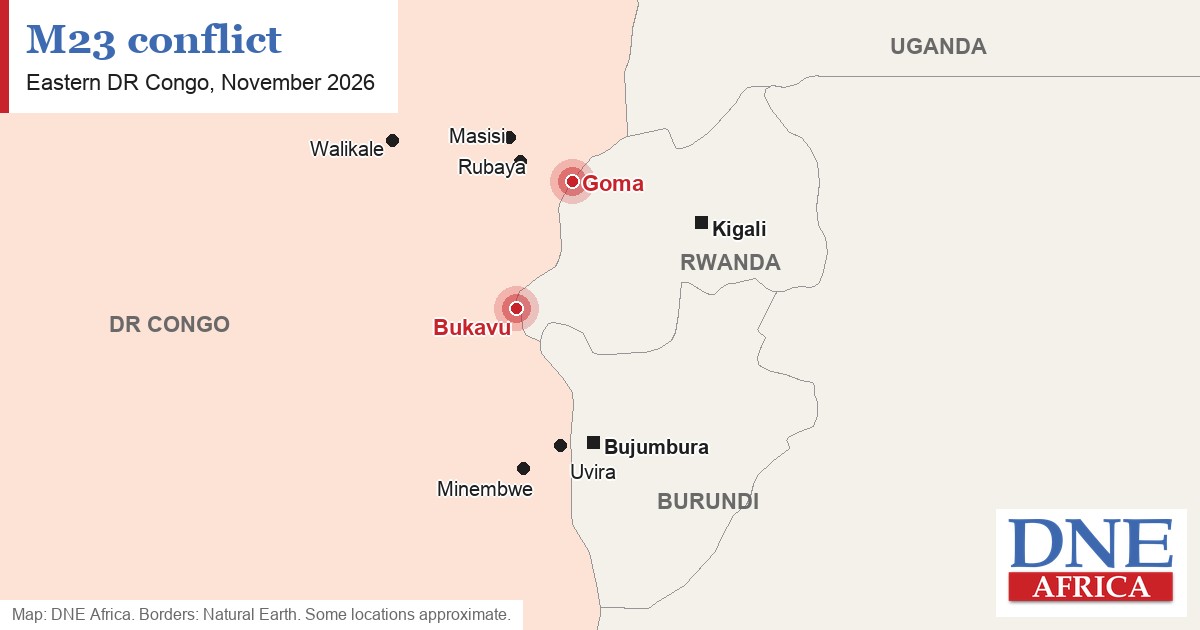
- The M23 and its political allies have held Goma since January 2025 and Bukavu since February 2025; fighting continues in Masisi, Walikale, Kalehe and the South Kivu high plateaux around Minembwe.
- On 12 October 2026 the Alliance Fleuve Congo (AFC/M23) was replaced in Goma by the Front for the Refoundation of the Nation (FRN), with Kabila as president.
- DR Congo and Rwanda signed the Washington Accords on 4 December 2025, and Kinshasa and the AFC/M23 signed the Doha Framework for Peace on 15 November 2025, but fighting has not stopped.
- The European Commission’s humanitarian office puts the number of displaced people in DR Congo at 8.2mn, most of them in the east.
What is happening in the M23 conflict now?
Fighting in the M23 conflict has spread through South Kivu since early November. Clashes in the Kalehe, Walungu, Uvira, Fizi and Shabunda territories displaced more than 100,000 people, the UN Office for the Coordination of Humanitarian Affairs (OCHA) said in a situation report covering 31 October. Médecins Sans Frontières moved patients out of the hospital in Bunyakiri after drone strikes nearby on 13 November, as DNE Africa reported.
The FRN holds Goma, Bukavu and the Rubaya coltan mines. Rubaya produces about 15% of the world’s coltan, John Ngono of the conflict monitor ACLED told ISS Africa, and UN experts estimate it earns the group about $800,000 a month. ACLED says the group has run a counter-offensive since July to stop the army from taking Minembwe, its main base in the South Kivu high plateaux.
Drones now shape the M23 conflict on both sides. The UN Group of Experts said in its final report, released in June 2026, that the M23 used attack drones against Kisangani airport in February, about 400km from the front. The army uses Turkish and Chinese drones, according to the same report. Pro-government militias known as Wazalendo fight alongside the army, and clashes between them and the FRN have emptied villages in Masisi.
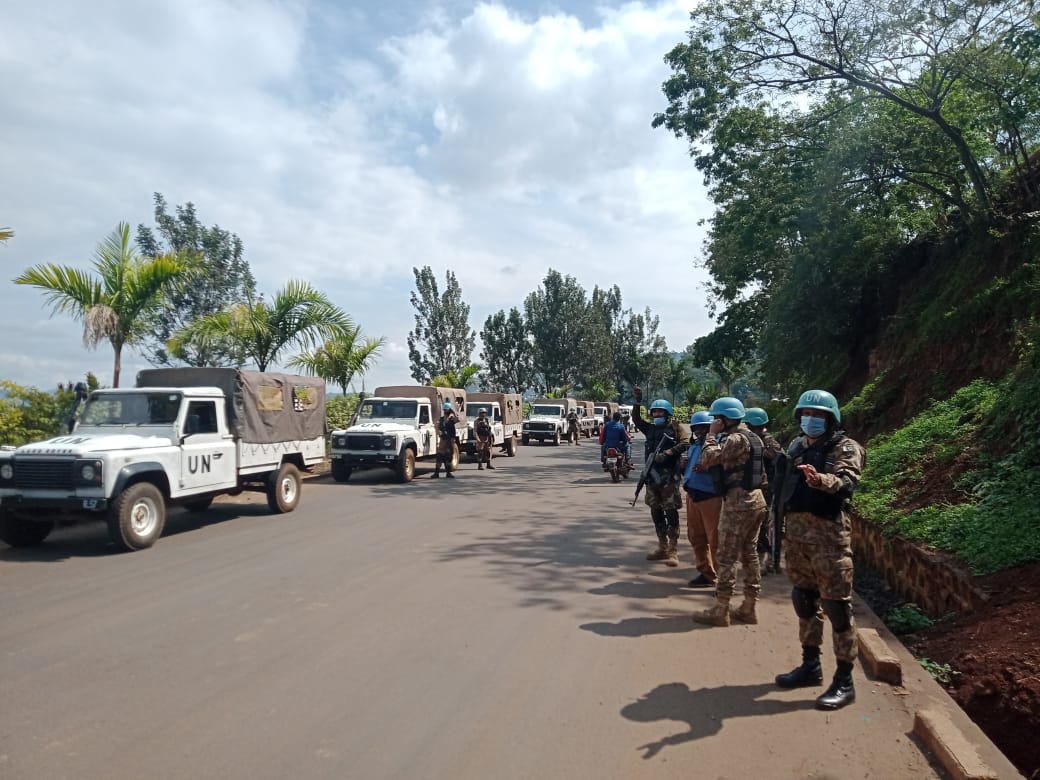
Who are the parties in the M23 conflict and what does each say it wants?
DR Congo’s government. President Felix Tshisekedi’s government describes the M23 conflict as “Rwandan aggression” rather than a rebellion. It demands that Rwandan troops leave Congolese territory and that state authority be restored in the areas the group holds. On 4 November the government spokesman, Patrick Muyaya, said the FRN “will not reach Kinshasa”, Actualite.cd reported in French. He said Kabila had “no army” and depended on Rwanda’s.
The FRN, formerly AFC/M23. The M23, or March 23 Movement, is an armed group formed in 2012 by former soldiers. The Alliance Fleuve Congo, its political coalition led by Corneille Nangaa, was set up in 2023. Their founding declaration of 12 October 2026, signed in Goma, made Kabila president of the FRN, with Bertrand Bisimwa and Nangaa as vice-presidents and Sultani Makenga as military chief, KT Press reported. The declaration accuses the government of “repression, corruption, discrimination”, promises the return of refugees and exiles, and lists the use of force among its means. A military court in Kinshasa sentenced Kabila to death in absentia in 2025 on charges including treason; he has rejected the case.
Rwanda. Rwanda’s government says its “defensive measures” on the border respond to the threat from the FDLR, an armed group founded by Hutu extremists linked to the 1994 genocide against the Tutsi, and that they will be adjusted as that threat falls. Foreign Minister Olivier Nduhungirehe has said the Washington Accords require Kinshasa to neutralise the FDLR, not to negotiate with it, after DR Congo signed a disarmament protocol with the group on 28 July 2026, The New Times reported. Rwanda rejects Kinshasa’s accusations of aggression. UN experts have reported the presence of Rwandan troops in the Kivus.
Allies. Burundian troops fight alongside the Congolese army in South Kivu. The Wazalendo militias, which Kinshasa treats as reservists, back the army. Uganda has troops in North Kivu and Ituri fighting a separate group, the ADF.
How did the M23 conflict begin?
The M23 takes its name from a peace deal of 23 March 2009 between Kinshasa and an earlier Tutsi-led armed group, the CNDP. Former CNDP fighters who had joined the army mutinied in 2012, saying the deal had not been honoured.
- April 2012: former CNDP soldiers mutiny and form the M23.
- November 2012: the M23 briefly takes Goma.
- November 2013: the army and a UN intervention brigade defeat the M23.
- November 2021: the M23 resumes attacks in North Kivu.
- January 2025: the M23 and the AFC take Goma.
- February 2025: they take Bukavu, South Kivu’s capital.
- 27 June 2025: DR Congo and Rwanda sign a peace agreement in Washington.
- 15 November 2025: Kinshasa and the AFC/M23 sign the Doha Framework for Peace.
- 4 December 2025: Tshisekedi and Rwanda’s President Paul Kagame sign the Washington Accords.
- December 2025: the M23 takes Uvira; it withdraws in January 2026 and the army returns.
- March 2026: the US sanctions the Rwanda Defence Force and four senior officers.
- 12 October 2026: the FRN is launched in Goma with Kabila as president.
- 11 November 2026: a UN sanctions committee adds the FRN to its listing of the AFC.
What is the human cost of the M23 conflict?
There is no agreed death toll for the M23 conflict. DR Congo’s government said in February 2025 that about 7,000 people had been killed since January of that year, a figure that has not been independently verified. In a letter to the UN Security Council on 24 August 2026, Kinshasa reported more than 300 deaths in June and July in areas it says are “occupied” by Rwanda’s army and its allies; Rwanda rejected the allegations, Security Council Report said.
DR Congo has about 8.2mn displaced people, including 5.8mn inside the country, and the number could reach 9mn by the end of 2026, according to the European Commission’s humanitarian aid department, which says 90% of the internally displaced are in North Kivu, South Kivu and Ituri. OCHA’s preliminary estimate of more than 323,000 people displaced in four days in Kalehe and Kabare in November shows how fast the numbers move.
Human Rights Watch has documented killings and abuses of civilians by the M23 in Uvira and elsewhere, and Amnesty International said in September 2026 that the group abused artisanal miners. Rights groups have also reported abuses by the army and the Wazalendo in the M23 conflict. An Ebola outbreak in the east, with more than 11,000 cases, has added to the strain, as DNE Africa reported.
What are neighbours, the AU, the UN and outside powers doing about the M23 conflict?
Two peace tracks on the M23 conflict run side by side. The US-brokered Washington Accords between DR Congo and Rwanda link the lifting of Rwanda’s “defensive measures” to the neutralisation of the FDLR. Each side accuses the other of violating them. In March 2026 the US Treasury sanctioned the Rwanda Defence Force and four of its officers, saying it expected the “immediate withdrawal” of Rwandan troops. Rwanda called the pressure one-sided.
The Qatar-mediated Doha process between Kinshasa and the AFC/M23 produced a framework in November 2025 with eight protocols, of which only two, on ceasefire monitoring and prisoner exchanges, had been signed, according to the Congolese research centre Ebuteli. In August 2026 the parties agreed a roadmap for the rest at a meeting in Switzerland. A verification team run by the regional body ICGLR, supported by the UN mission MONUSCO, visited Minembwe and Masisi in August and September.
The African Union’s mediator is Togo’s Faure Gnassingbe, whose team agreed a political roadmap in Gaborone in July 2026. MONUSCO’s mandate, renewed by resolution 2808 in December 2025, comes up for renewal in December 2026; Tshisekedi has asked that it be given ceasefire monitoring explicitly. On 11 November the UN sanctions committee on DR Congo added the FRN to its entry for the AFC, according to a UN press release, as DNE Africa reported. Kenya and DR Congo agreed this month to restore ambassadors, after a rift that began when the AFC was launched in Nairobi in December 2023.
African Narratives, an African think tank based in Cairo and N’Djamena, examined the M23 conflict after the fall of Goma in a 2025 study by political researcher Nashwa Abdelnaby. It traced the war to the legacy of Rwandan and Ugandan interventions in the Congo wars of the late 1990s, to Hutu-Tutsi rivalries that it said local and regional actors exploit, and to competition for minerals smuggled out through neighbouring states, an accusation Rwanda rejects. It warned that the Islamic State Central Africa Province was using the security vacuum to expand. The study found that the Kenya-led Nairobi Process, launched in April 2022, failed to bring all the main actors in, which bred mistrust between Kenya and DR Congo, and it recommended direct talks between the two heads of state, judicial co-operation to end impunity and a stronger security partnership.
Crisis Group said in a December 2025 report that the army, the M23 and Rwandan forces kept fighting despite the Washington and Doha deals. ISS Africa assessed in November 2026 that drones had given the group the reach of a regular army.
What to watch next in the M23 conflict
- Whether the army takes Minembwe, or the FRN pushes further toward Walikale, Uvira or Kisangani.
- The renewal of MONUSCO’s mandate in December and whether it includes ceasefire monitoring.
- The remaining Doha protocols, and whether Kinshasa will negotiate with a movement led by Kabila.
- Progress on the FDLR and on Rwanda’s “defensive measures” under the Washington Accords, and any new US sanctions linked to the M23 conflict.
FAQ
What is the M23 conflict?
The M23 conflict is the war in eastern DR Congo between the Congolese army and allied militias and the M23 armed group, now part of the Kabila-led FRN. It resumed in November 2021.
Who controls Goma and Bukavu?
The M23 and its political allies have controlled Goma since January 2025 and Bukavu since February 2025. DR Congo’s government still claims both cities.
What is Rwanda’s role in the M23 conflict?
Kinshasa, UN experts and the US say Rwanda backs the group with troops. Rwanda says it has taken “defensive measures” against the FDLR and rejects being a party to the conflict.
Is there a ceasefire?
Ceasefire commitments exist under the Washington Accords and the Doha framework, and a verification team has started work, but fighting continues across North and South Kivu.


