

King Mohammed VI on Wednesday approved a roadmap for the Morocco defence industry that aims to create around 50,000 jobs and meet about 40% of the armed forces’ and security services’ equipment needs by 2035, the Royal Office said.
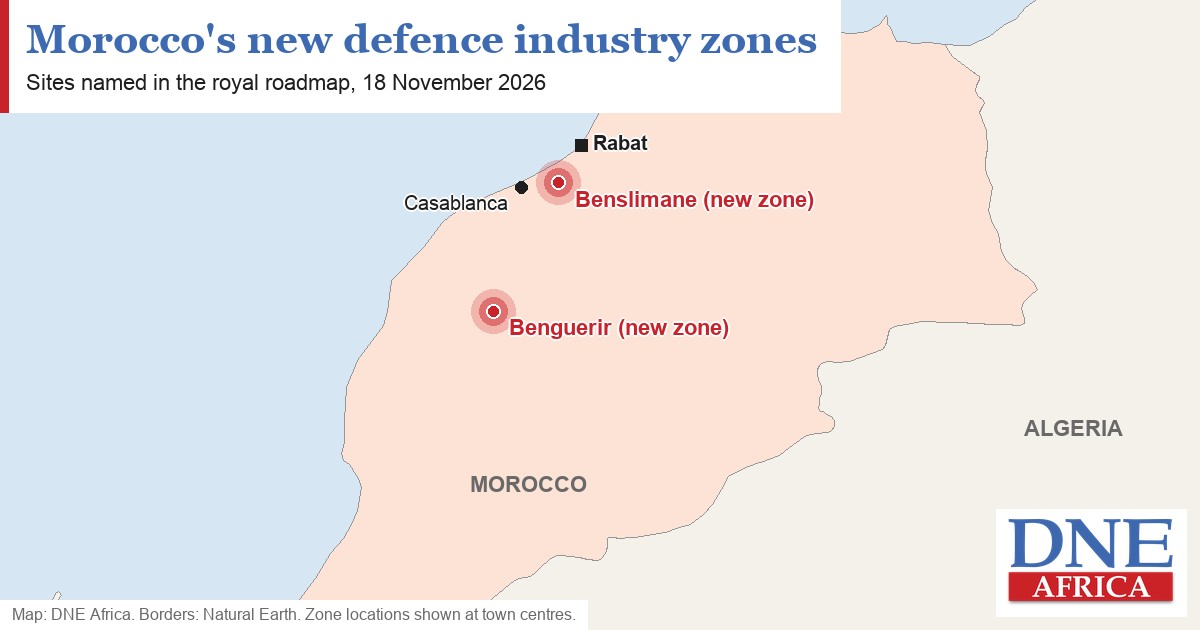
The plan sets up a strategic agency, an industrial holding company and two new industrial zones at Benguerir and Benslimane, backed by 4bn dirhams (about $430mn) from the Hassan II Fund for Economic and Social Development. It is Morocco’s clearest attempt yet to turn heavy arms spending into a domestic, export-led industry.
What does the Morocco defence industry roadmap include?
The King chaired a working session at the Royal Palace in Rabat, attended by Crown Prince Moulay El Hassan, at which the “Morocco Offer” and the roadmap were presented, the Royal Office said in a statement. The presentation was made by Lieutenant General Mohammed Berrid, Inspector General of the Royal Armed Forces, and the head of the Moroccan Investment and Export Development Agency (AMDIE).
The statement said the plan for the Morocco defence industry covers the whole value chain: design and production, maintenance, testing and storage. Priority areas named include drones and autonomous systems, land and naval systems, defence electronics, cyberdefence and artificial intelligence, with an emphasis on dual-use technology.
Governance will rest on a dedicated strategic agency to carry out the national strategy and support investors, and on an industrial holding company to structure the sector, raise public and private capital and help local champions emerge. A specialised academy will train engineers and technicians, drawing on civilian, military and diaspora expertise, the statement said.
What are the targets for 2035?
By 2035, the defence and security industrial base is expected to create around 50,000 direct and indirect jobs, cover about 40% of the needs of the Royal Armed Forces and security agencies, and earn more than 65% of its revenue from exports, according to the statement.
The King instructed officials to set up the governance bodies and a financing plan first, simplify investment procedures and bring in the private sector. The Hassan II Fund will contribute 4bn dirhams. The new zones at Benguerir and Benslimane come on top of the two defence industrial acceleration zones already in place. The statement said investors had shown interest in projects in Morocco, particularly for export, but did not name them.
The session was attended by Head of Government Fatima Ezzahra El Mansouri, royal adviser Fouad Ali El Himma, Industry and Trade Minister Ryad Mezzour and Abdeltif Loudiyi, the minister delegate in charge of the National Defence Administration.
How big is Morocco’s defence spending?
The plan builds on a legal framework that began with Law 10-20 on defence and security equipment, adopted in 2020, and a 2024 decree creating two industrial acceleration zones for weapons systems, ammunition and security equipment, Hespress noted.
Spending authority is rising fast. The 2026 finance law set a ceiling of 157.2bn dirhams for multi-year defence commitments, up 17.8% on 2025, and the draft 2027 budget proposes raising it to 190.5bn dirhams, Morocco World News reported. Those ceilings cover long-term contracts, not a single year’s spending.
Morocco already has a large aerospace and automotive industry, which the Royal Office cited as a base for the Morocco defence industry. Recent DNE Africa reporting covered other state-backed economic plans, including extra funding for housing aid and a share sale on the Casablanca bourse.
What happens next?
The next steps named by the King are the agency, the holding company and a financing plan. The government has not yet published a timetable, a total investment figure or a list of partners. How quickly the Benguerir and Benslimane zones attract manufacturers will be the first test of the Morocco defence industry targets for 2035.
FAQ
What is the Morocco defence industry roadmap?
It is a national plan, approved by King Mohammed VI on 18 November 2026, to build a defence and security industry covering design, production, maintenance, testing and storage, with a strategic agency, a holding company and new industrial zones.
How many jobs will the Morocco defence industry create?
The Royal Office said the sector is expected to create around 50,000 direct and indirect jobs by 2035.
Where are the new Morocco defence industry zones?
The plan adds a large zone at Benguerir and another at Benslimane to the two defence industrial acceleration zones already in place.
How is the plan funded?
The Hassan II Fund for Economic and Social Development will contribute 4bn dirhams. A wider financing plan is still to be drawn up.


