
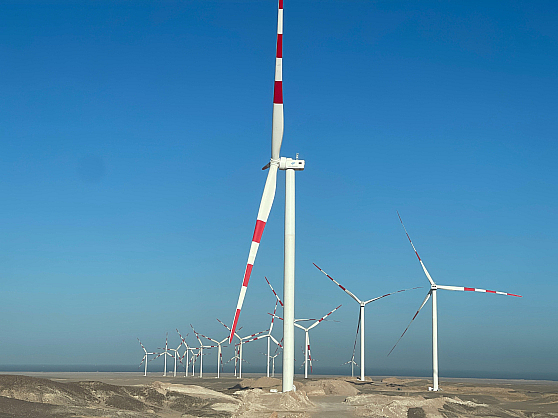

ENGIE and its partners have reached financial close on the 900MW Gulf of Suez wind farm known as Gulf of Suez 3, near Ras Shokeir in Egypt, allowing full construction to start, the French energy group said on Monday.
The project will be ENGIE’s largest onshore wind farm worldwide, the company said. It is expected to generate about 4 terawatt hours (TWh) of electricity a year and adds to a government push to raise the share of renewables in Egypt’s power mix.
Who owns and finances the Gulf of Suez wind farm?
The Gulf of Suez wind farm will be built, owned and operated by Shokeir Wind Energy, a project company owned by Aeolus (40%), ENGIE (35%) and Orascom Construction (25%), according to an ENGIE statement. Aeolus is an African renewable energy platform of Japan’s Toyota Tsusho. ENGIE is the lead developer.
The non-recourse debt comes from the Japan Bank for International Cooperation (JBIC), France’s Proparco, the Dutch development bank FMO, Société Générale, Crédit Agricole CIB and KfW IPEX-Bank, the company said. Lending from the commercial banks is insured by Nippon Export and Investment Insurance (NEXI). HSBC Bank Egypt is the working capital bank. ENGIE did not disclose the size of the loans or the total cost of the project.
Revenue is secured by a 25-year power purchase agreement with the state-owned Egyptian Electricity Transmission Company (EETC), whose payment obligations are backed by Egypt’s Ministry of Finance. The New and Renewable Energy Authority has provided the land under a 25-year usufruct agreement. The consortium signed the purchase agreement in March, when it said it expected financial close in the third quarter of 2026.
When will the Gulf of Suez wind farm produce power?
The plant will be connected to the grid in three phases. The first 300MW is expected to begin commissioning in January 2028, with full commercial operation of all 900MW planned for the third quarter of 2028, ENGIE said. Earlier statements had targeted first power in December 2027 and full operation by mid-2028.
Orascom Construction will carry out the civil and electrical works for the balance of plant and supply some local components. China’s Goldwind will supply, install and commission the turbines.
“Reaching financial close for this 900 MW project marks a major milestone for ENGIE,” said Rik De Buyserie, chief executive of ENGIE North Africa. Mohamed Awny, chief executive of ENGIE Egypt, said the project built on the group’s two earlier Egyptian wind farms.
What does the project mean for Egypt’s renewable energy target?
The new Gulf of Suez wind farm is the third ENGIE and its partners have developed in Egypt, after Ras Ghareb (262.5MW) and Red Sea Wind Energy (650MW). Together the three will have close to 2 gigawatts (GW) of capacity, the company said.
The government aims to generate 45% of Egypt’s electricity from renewable sources by 2028, replacing an earlier goal of 42% by 2030, the Presidency said in October, Ahram Online reported. The electricity minister said at the time that 10.5GW of renewable capacity was connected to the national grid. The Gulf of Suez coast, with steady strong winds, hosts most of the country’s wind farms, and a new 500kV line is planned to carry their power to the main consumption centres.
Egypt’s renewables drive is part of wider economic planning set out in the 2026/27 development plan. The Gulf of Suez wind farm also reflects growing Japanese and European development-bank lending to African power projects, as other countries, such as Mozambique, pitch themselves as regional energy hubs.
FAQ
What is the Gulf of Suez wind farm?
A 900MW onshore wind farm near Ras Shokeir on Egypt’s Gulf of Suez coast, developed by ENGIE, Orascom Construction and Aeolus. ENGIE says it will be its largest onshore wind farm worldwide.
Who buys the power from the Gulf of Suez wind farm?
The state-owned Egyptian Electricity Transmission Company, under a 25-year power purchase agreement backed by Egypt’s Ministry of Finance.
When will the Gulf of Suez wind farm start operating?
The first 300MW phase is expected to start commissioning in January 2028, and full commercial operation is planned for the third quarter of 2028, according to ENGIE.
How much electricity will it generate?
About 4TWh a year, according to ENGIE.


