
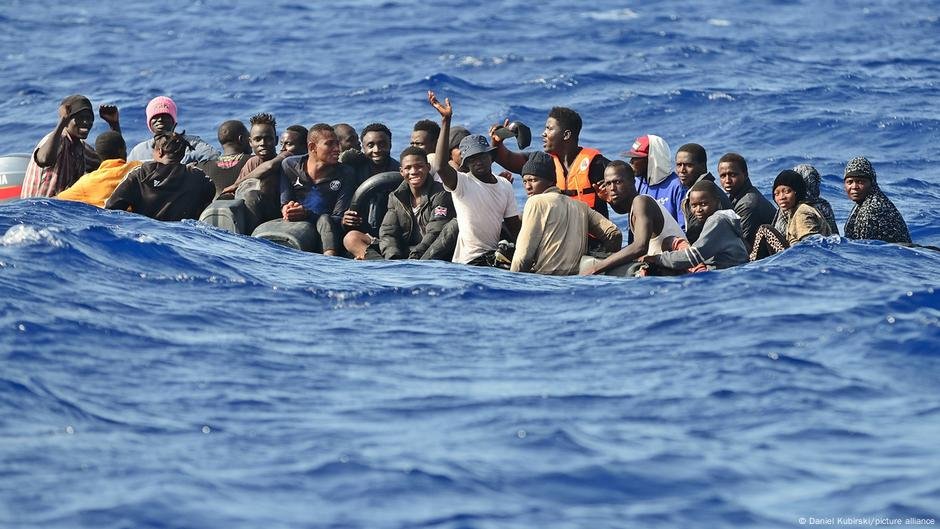

Thousands of African migrants attempting to reach Europe continue to face exploitation, human trafficking and life-threatening journeys at sea, as international law enforcement agencies intensify efforts to dismantle criminal networks operating along major migration routes.
A major INTERPOL-led operation targeting migrant smuggling and human trafficking networks across the Mediterranean and West African Atlantic routes has resulted in the arrest of 262 suspects, the identification of 41 organised criminal groups and the opening of 434 new investigations.
The operation, known as Operation Commons Maris, also identified 109 potential victims of human trafficking and detected 1,715 irregular migrants, highlighting the scale of criminal activities targeting vulnerable people seeking to reach Europe.
According to INTERPOL, 221 of those arrested face allegations of migrant smuggling, 16 are suspected of human trafficking, while another 25 were detained over offences including the production and use of fraudulent documents.
Conducted between October 5 and 8, the four-day operation involved law enforcement and border control agencies from 16 countries across North Africa, West Africa, Southern Europe and the Middle East.
Participating countries included Algeria, Morocco, Tunisia, Libya, Mauritania, Senegal, The Gambia, France, Italy, Spain, Portugal, Greece, Malta, Cyprus, Turkey and Syria.
INTERPOL coordinated the operation with support from the European Union Agency for Law Enforcement Cooperation (Europol), the European Border and Coast Guard Agency (Frontex), the African Union Mechanism for Police Cooperation (AFRIPOL), the International Organization for Migration (IOM) and the United Nations Office on Drugs and Crime (UNODC).
The European Union funded the operation under its Protect project.
Overcrowded Boats and Children Among Those Rescued
Investigations during the operation exposed the dangerous conditions in which migrant-smuggling networks transport people across African and European maritime routes.
In southern Morocco, authorities intercepted a boat carrying 70 people, including 30 minors, who had reportedly spent six days at sea attempting to reach their destination.
In another incident, Senegalese authorities alerted neighbouring countries after a boat left their territorial waters. Mauritanian authorities intercepted the wooden vessel the following day, finding 80 passengers, including two children, and arresting three suspected organisers of the journey.
In Tunisia, security forces disrupted a planned crossing before departure and arrested three suspected human traffickers, seizing a boat, a marine engine and other equipment.
Meanwhile, Libyan authorities rescued 34 people believed to be victims of human trafficking and arrested three suspected members of an organised criminal group allegedly involved in human trafficking, migrant smuggling and extortion.
In Algeria, six suspects were arrested in an investigation targeting a migrant-smuggling network, with authorities also examining allegations of endangering minors.
Moroccan authorities separately arrested a suspected supplier of fraudulent passports accused of recruiting people for irregular migration.
INTERPOL also identified dozens of social media posts, groups and accounts allegedly advertising irregular migration opportunities and migrant-smuggling services.
The organisation said the intelligence gathered during the operation could generate further investigative leads and arrests in the coming weeks and months.
More Than 2,200 Migrants Dead or Missing in 2026
The crackdown comes against the backdrop of mounting fatalities along migration routes connecting Africa to Europe.
INTERPOL’s Director of Organised and Emerging Crime, David Caunter, described the Mediterranean as one of the world’s most dangerous migration routes, warning that criminal networks exploit vulnerable people through abuse, extortion and human trafficking.
He also highlighted the dangers posed by overcrowded and unseaworthy boats used to transport migrants across the sea.
Data from the International Organization for Migration (IOM), published on September 17, showed that at least 2,292 people had died or gone missing while attempting to cross the sea towards Europe between January and September 15, 2026.
This compared with 1,999 deaths and disappearances during the same period in 2025, despite a 39 per cent decline in sea arrivals to approximately 60,000.
According to the IOM, fatalities along the Central Mediterranean route towards Italy increased from 844 to 996, while deaths along the Eastern Mediterranean route rose from 284 to 417.
A further 879 deaths were recorded along the Atlantic and Western Mediterranean routes towards Spain.
The organisation warned that the actual death toll could be higher because many shipwrecks and disappearances at sea go unreported.
IOM Director General Amy Pope said the increase in fatalities despite fewer arrivals demonstrated that migrants were increasingly undertaking dangerous journeys.
Separate INTERPOL-Linked Arrests in South Africa
Meanwhile, South African authorities have arrested nine Zimbabwean nationals suspected of attempting to travel from the country to participate in the ongoing Russia-Ukraine war.
The suspects, aged between 20 and 26, were arrested on Sunday night during a joint operation at OR Tambo International Airport in Johannesburg and a hotel in Bruma, east of the city.
The operation involved South Africa’s elite crime-fighting unit, the Directorate for Priority Crime Investigation, commonly known as the Hawks, INTERPOL, international law enforcement agencies and local police intelligence units.
According to South African police, five suspects were arrested at OR Tambo International Airport, while the remaining four were apprehended at the hotel in Bruma as they allegedly prepared to board international flights.
Police confirmed that all nine suspects were foreign nationals who were not resident in South Africa.
The suspects are expected to appear before the Kempton Park Magistrates’ Court to face charges relating to the alleged contravention of South Africa’s Regulation of Foreign Military Assistance Act 15 of 1998.
Authorities have not established whether the Zimbabwean nationals intended to fight on behalf of Russia or Ukraine, nor have they disclosed the identities of the organisations or individuals allegedly involved in facilitating their travel.
The arrests followed an intelligence-led investigation involving several domestic and international law enforcement agencies.
Although the South African arrests are unrelated to Operation Commons Maris, both developments demonstrate the expanding role of international police cooperation in investigating cross-border criminal networks and addressing security challenges involving multiple countries.


