


The fintech economics of OPay and Moniepoint differ sharply: OPay reported $536.25mn in revenue and $110.79mn in pre-tax income for 2025, while Moniepoint does not disclose revenue or profit, according to a TechCabal analysis.
The two Nigerian payments groups, both holders of microfinance bank licences, processed a combined $644.85bn in 2025, out of more than ₦1.2 quadrillion ($880.51bn) of electronic transactions in Nigeria, TechCabal reported.
How big are OPay and Moniepoint?
Moniepoint said it processed 14 billion transactions worth ₦412 trillion ($286.85bn) in 2025 and serves more than 20 million businesses and individuals. OPay processed 62.3 billion transactions worth $358bn and reported 50.1 million monthly active users.
OPay therefore handled 4.45 times as many transactions, but Moniepoint’s average transaction value of $20.49 was about 3.56 times OPay’s $5.75. TechCabal said the gap could reflect Moniepoint’s concentration on merchant payments and OPay’s on frequent consumer transfers, but called this a hypothesis the disclosures cannot confirm.
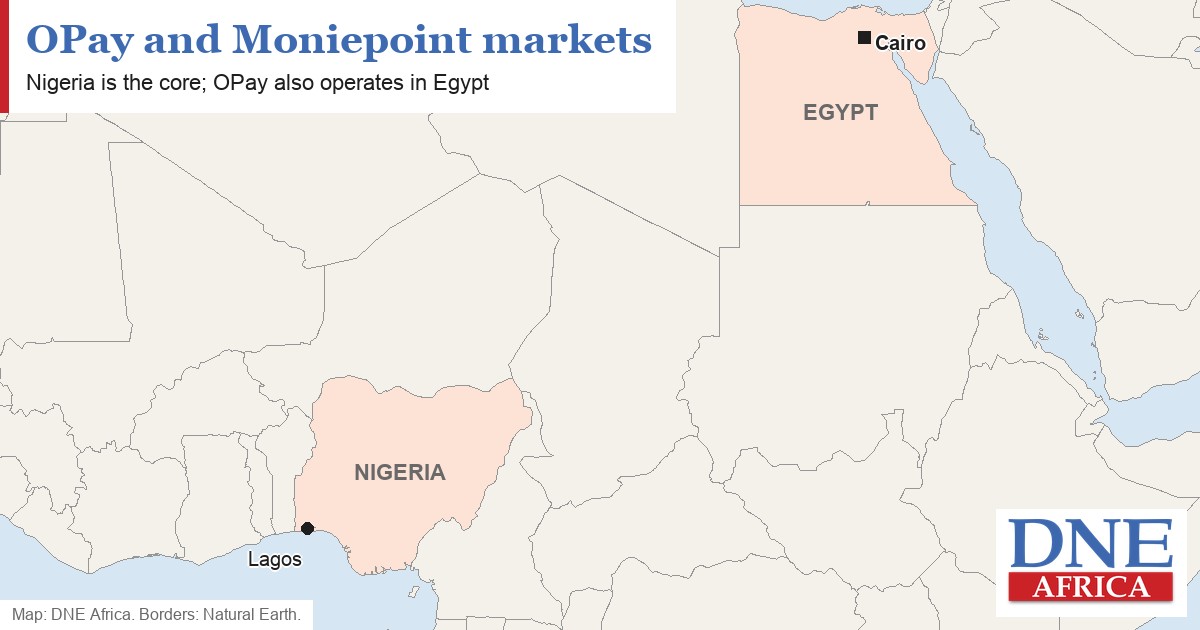
OPay generated 88.1% of its 2025 revenue in Nigeria. It also operates in Egypt, Indonesia and Pakistan. Moniepoint operates largely in Nigeria, with a recent expansion into Kenya.
What do the fintech economics say about profit?
OPay’s revenue was about 0.15% of the $358bn it processed. Its pre-tax income of $110.79mn is a margin of about 20.66%, or roughly 21 cents per dollar of revenue, TechCabal calculated.
Moniepoint has published no such figures. Applying OPay’s ratios to Moniepoint’s volume gives illustrative revenue of about $430.28mn and an estimated profit of $88.89mn. TechCabal stressed that this is an indicative estimate, not a reported result, and assumes similar fees and costs at both companies.

How important is lending to the fintech economics?
Lending is now a large part of the fintech economics at both groups, which use payment histories to extend credit. OPay originated $938.3mn of new loans in Nigeria in 2025, up 284.71%. Its loan financing revenue rose to $260.3mn from $71.5mn, or 48.5% of total revenue.
The risk is also rising. OPay’s provision for expected credit losses increased from $24.8mn to $121.3mn, about 46.6% of loan financing revenue. TechCabal noted that a provision is not the same as realised losses. Quarterly unique borrowers in Nigeria reached 4.6 million, from 2.1 million a year earlier.
Moniepoint said it disbursed more than ₦1 trillion ($696.23mn) in loans to small businesses in 2025, against $71mn of working capital loans in 2023, and that borrowers saw average transaction values rise 36%. It said its non-performing loans are small. Its lending economics are not public. The Central Bank of Nigeria reported that industry non-performing loans rose to 7% in 2025.
What could change the fintech economics?
In June 2026 the Central Bank of Nigeria issued a circular saying any licensed institution controlling more than 25% of the consumer-issuing market would be limited to 15% of merchant acquiring. TechCabal said this adds a variable for both companies, whose growth will depend on how they position across the payments chain.
Readers can follow related coverage of Nigeria’s mobile market and Africa’s 2026 tech boom.
FAQ
What are the fintech economics of OPay?
OPay reported $536.25mn in revenue and $110.79mn in pre-tax income for 2025, with nearly half of revenue from loan financing, according to TechCabal.
Does Moniepoint publish its profit?
No. Moniepoint does not disclose revenue or profit. TechCabal’s estimate of $88.89mn profit applies OPay’s ratios and is not a reported figure.
Why is lending central to fintech economics in Nigeria?
Payment data lets both firms assess borrowers. OPay’s loan revenue was 48.5% of its total, but credit-loss provisions rose almost fivefold to $121.3mn.
Which rule could limit the two firms?
A June 2026 central bank circular caps merchant acquiring at 15% for institutions with over 25% of the consumer-issuing market.