
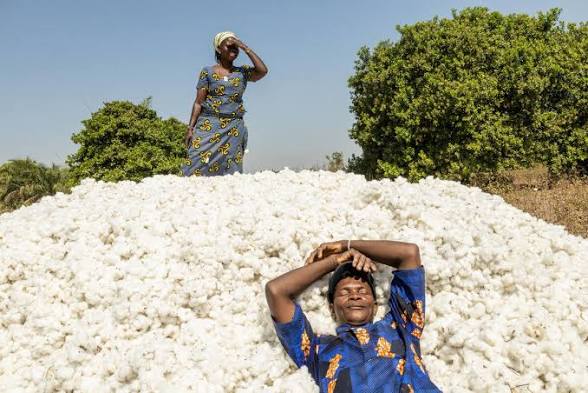

Benin emerged as Africa’s leading cotton producer in the 2019/2020 agricultural season, ahead of Mali, Côte d’Ivoire and Burkina Faso, highlighting the growing importance of the crop to West Africa’s agricultural economy.
The country produced approximately 320,000 tonnes of cotton lint during the season, according to figures compiled from the International Cotton Advisory Committee (ICAC).
Benin’s performance followed a significant increase in seed cotton production, which reached a record 678,000.3 tonnes in the 2018/2019 season, compared with 597,573.2 tonnes in 2017/2018, representing growth of 13.4%, according to UMOA-Titres.
Production forecasts for the 2019/2020 season had initially stood at 732,273 tonnes of seed cotton.
Africa’s top 10 cotton-producing countries
ICAC-based figures published in the Development Cooperation Review show the following ranking of Africa’s leading cotton producers in the 2019/2020 season:
- Benin: 320,000 tonnes
- Mali: 310,000 tonnes
- Côte d’Ivoire: 220,000 tonnes
- Burkina Faso: 210,000 tonnes
- Cameroon: 140,000 tonnes
- Sudan: 130,000 tonnes
- Tanzania: 110,000 tonnes
- Egypt: 70,000 tonnes
- Zimbabwe: 60,000 tonnes
- Ethiopia: 60,000 tonnes
The five leading producers accounted for approximately 84% of Africa’s total cotton production, estimated at 1.92 million tonnes during the 2019/2020 season.
Agriculture remains central to Benin’s economy
Agriculture remains a major pillar of Benin’s economy, which recorded growth of 6.9% in 2019, up from 6.7% in 2018.
The country’s economic expansion was supported by strong agricultural production, particularly cotton and food crops, alongside increased construction activity, the development of agro-industries and improvements in electricity supply.
The performance of the Port of Cotonou also contributed to economic activity through its impact on transport, trade and logistics.
Benin’s primary sector expanded by 5.2% in 2019, while the secondary sector recorded growth of 13.6%, supported by construction, food-processing industries and electricity generation.
The services sector grew by 5.2%, driven by telecommunications, hotels, restaurants and other activities.
Reforms strengthen cotton production and investment
The expansion of the cotton industry has been supported by government reforms aimed at improving agricultural production, strengthening value chains and attracting investment.
The launch of the Maria-Gléta 2 power plant in August 2019, with an installed capacity of 127 megawatts, was another step towards strengthening the country’s energy infrastructure and supporting industrial development.
Benin also registered more than 19,200 domestic and foreign companies between January and August 2019, according to the Investment and Export Promotion Agency (APIEX).
The government’s agricultural development agenda includes the Strategic Plan for the Development of the Agricultural Sector 2017-2025 and the National Agricultural, Food Security and Nutrition Investment Plan 2017-2021.
These programmes focus on seven agricultural development zones and the promotion of key value chains, including cotton, rice, cassava, pineapple, maize and cashew.
Benin’s performance in cotton production illustrates the importance of agricultural investment, improved production systems and economic reforms in strengthening the competitiveness of African economies.


