
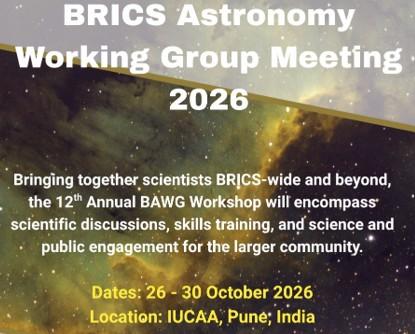

South Africa will participate in the 12th Annual BRICS Astronomy Working Group (BAWG) Meeting in India from October 26 to 30, seeking to strengthen scientific cooperation, advance joint research and expand collaboration among BRICS member countries.
The meeting will focus on multi-messenger and multi-wavelength transients, while exploring opportunities for collaborative research, skills development and public engagement in astronomy, according to the South Africa’s National Research Foundation (NRF).
Takalani Nemaungani, chief director of astronomy at South Africa’s Department of Science, Technology and Innovation, will lead the country’s 17-member delegation. It includes representatives from the South African Astronomical Observatory, the South African Radio Astronomy Observatory, the University of Cape Town, the University of the Western Cape, the Inter-University Institute for Data Intensive Astronomy and the University of Johannesburg.
The South African delegation will take part in presentations on the state of astronomy across BRICS member countries, highlighting scientific advances, strategic priorities and policy perspectives.
The discussions are expected to support collective planning and help identify shared challenges and opportunities within the BRICS astronomy community.
“Their participation highlights South Africa’s contribution to the Working Group and the role of national research institutions and universities in advancing collaborative astronomy,” the NRF said in a statement.
The meeting will bring together researchers, government representatives, educators and science communicators to review progress on existing initiatives, strengthen partnerships and identify new opportunities for cooperation in astronomical research and technology development.
The programme will also feature the BAWG Data Science Hackathon, organised in collaboration with the Aryabhatta Research Institute of Observational Sciences and the Indian Space Research Organisation.
Other activities will include science communication training, the launch of the BRICS Astronomy Robotics and Coding Training initiative, and a public exhibition showcasing astronomy facilities across BRICS countries.
Discussions will cover a broad range of areas, including scientific research, technology development, education, data science, human capital development and public engagement.


