
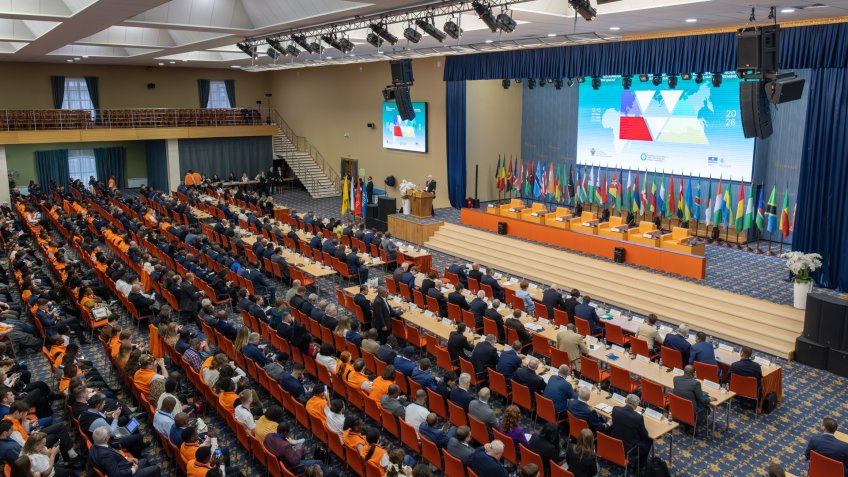

Delegates from 44 countries have adopted a Declaration at the Second Russian-African Raw Materials Dialogue in Saint Petersburg, setting out joint initiatives on staff training, deposit exploration and scientific cooperation, according to a report by TV BRICS.
The forum ran from 12 to 16 October 2026 and drew more than 500 participants, including delegates from over 40 African countries. It was organised by the Russian Ministry of Foreign Affairs, the UNESCO International Competence Centre for Mining Engineering Education and the Empress Catherine II Saint Petersburg Mining University. This year’s edition follows the first Dialogue, held in Saint Petersburg from 29 October to 1 November 2025.
Economic sovereignty framed the discussions. African delegates pressed for partnerships that keep more of the value chain on the continent. Ghana’s Minerals Commission noted that eight of the world’s top twenty gold producers are African, yet only about 2% of the continent’s natural resources are processed locally, and said Ghana will now prioritise partnerships that let it add value at home.
Speaking at the ministerial session, the Commission’s chief executive, Tandoh, said Ghana welcomes knowledge sharing and technology transfer, provided it is structured, locally embedded and leaves Ghanaian engineers and institutions with measurable new capabilities. He called for cooperation to become “a partnership of sovereign equals.”
Engineering education dominated the academic track. At a session for Russian and African rectors, Professor Francisca Oladipo, Vice-Chancellor of Nigeria’s Thomas Adewumi University, argued that training engineers should sit at the centre of minerals cooperation. She proposed joint postgraduate programmes in minerals processing and metallurgy, intelligent mining built on trusted African-owned data, and stronger pathways for technicians and technologists.
The Dialogue grew out of commitments made at the Second Russia-Africa Summit. Organisers describe it as a continuation of initiatives backed by President Vladimir Putin and Foreign Minister Sergey Lavrov at the 2023 summit in Saint Petersburg, and its stated goal is to develop concrete mechanisms for improving government regulation, introducing advanced technologies and training highly qualified personnel for the mineral resources sector.
Russian officials point to growing commercial ties as the backdrop. Russian diplomacy notes that trade with African countries has grown by more than 60% over the past five years.
For African governments, the test will come in implementation: whether the Declaration’s commitments translate into training places, exploration contracts and processing capacity on the continent itself.
TV BRICS correspondent Leonid Samuna reports from Saint Petersburg in the video above.
This report is published in partnership with TV BRICS.


