
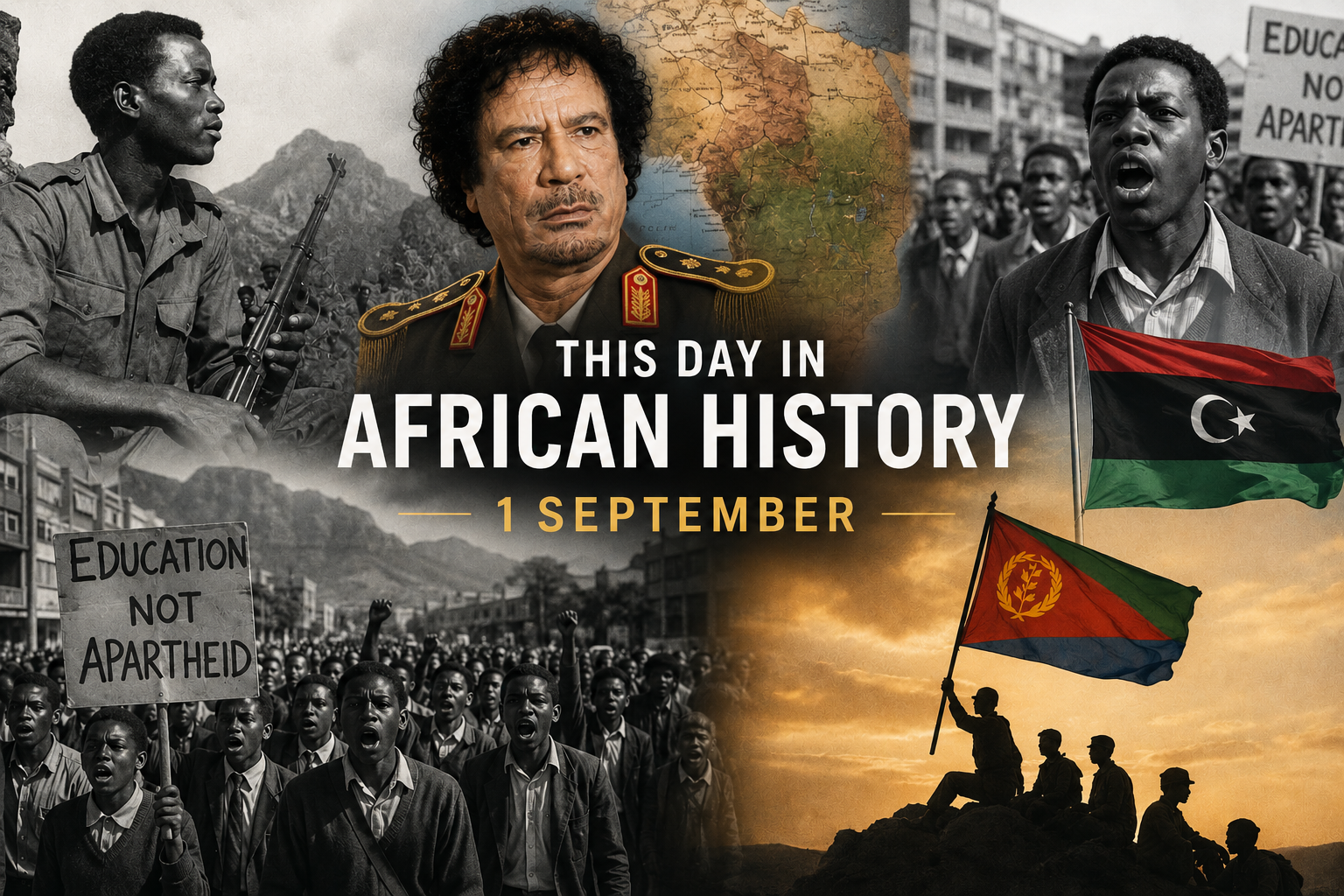

Sptember 1 carries a distinctive place in Africa’s modern history, linking the life of a celebrated Gambian writer and surgeon with political upheaval, a long-running independence struggle and student resistance against apartheid.
The date reflects some of the contrasting forces that have shaped the continent over the past century — from the intellectual and cultural contributions of African writers to struggles over political power, national sovereignty and social justice.
1932 — Lenrie Peters is born in The Gambia
On September 1, 1932, Lenrie Peters was born in Bathurst, now Banjul, The Gambia.
A physician, surgeon and writer, Peters built a career that crossed medicine and literature. He trained in Britain and became a Fellow of the Royal College of Surgeons, while also developing a reputation as one of West Africa’s notable literary voices.
His writing examined identity, colonialism and the social realities of post-colonial Africa. His novel The Second Round remains among his best-known works.
Peters was also active in education and held senior roles connected to the West African Examinations Council, contributing to the development of education in the region.
His career reflected the influence that African intellectuals could exert across several fields at a time when newly independent societies were seeking to define their institutions and cultural identities.
1961 — Eritrea’s armed struggle begins
Nearly three decades later, September 1 became associated with one of Africa’s longest liberation struggles.
In 1961, Hamid Idris Awate and a small group of Eritrean Liberation Front fighters confronted Ethiopian forces at Mount Adal in an encounter widely regarded as the beginning of Eritrea’s armed independence struggle.
Eritrea had been federated with Ethiopia under a United Nations arrangement after World War II. The federation was dissolved in 1962, and Eritrea was subsequently incorporated into Ethiopia, intensifying demands for independence.
The conflict continued for 30 years, involving successive liberation movements and resulting in significant political and humanitarian consequences.
Eritrean forces captured the capital, Asmara, in 1991, effectively ending Ethiopian rule. A UN-observed referendum two years later paved the way for Eritrea’s formal independence in 1993.
1969 — Libya’s monarchy falls
On September 1, 1969, Libya underwent a major political transformation when a group of young military officers overthrew the monarchy while King Idris was abroad receiving medical treatment.
The largely bloodless coup ended the Senussi monarchy and established the Libyan Arab Republic.
Muammar Gaddafi, then 27, emerged as the most prominent figure among the officers behind the takeover. He would remain Libya’s dominant political figure for more than four decades.
Under Gaddafi, Libya pursued an assertive foreign policy that increasingly focused on Africa. Tripoli developed close relations with several African governments and liberation movements, while Gaddafi later promoted a stronger pan-African political role for Libya.
His government’s involvement in African affairs made him an influential and divisive figure on the continent, particularly during the final decades of his rule.
1976 — Students take their protest to Cape Town
Seven years later, September 1 became another important date in Africa’s history of resistance.
Around 2,000 Black South African students from Langa, Nyanga and Gugulethu marched through central Cape Town in 1976, as student unrest spread across the country following the Soweto uprising in June.
The march was part of a broader wave of protests against apartheid and the government’s education policies. The September 1 demonstration proceeded without major obstruction, although subsequent protests in Cape Town were met with police action.
The student uprising of 1976 marked a turning point in the struggle against apartheid. Young South Africans increasingly became a driving force of political resistance, challenging the system both inside schools and across communities.
The events of that year would remain a defining chapter in South Africa’s history, with the courage of the students becoming an enduring symbol of resistance to apartheid.


