
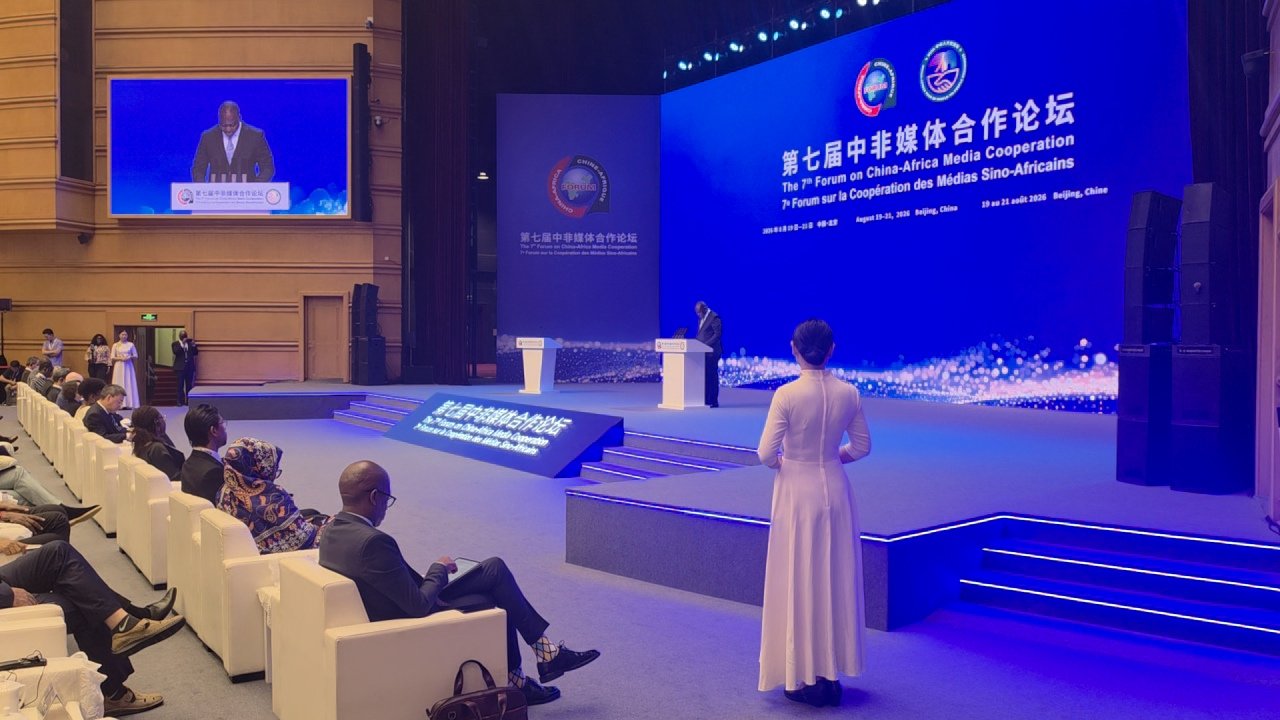

African officials and media leaders called for China-Africa media cooperation to move beyond equipment support and programme exchanges towards joint production and two-way storytelling, as the 7th Forum on China-Africa Media Cooperation opened in Beijing on Thursday.
The three-day forum brought together about 400 representatives from government, media, diplomacy, business and academia from China and 45 African countries. It comes as China and Africa mark 70 years since the establishment of diplomatic relations in 2026 and observe the China-Africa Year of People-to-People Exchanges.
In his remarks, Alhaji Mohamed Sarjoh Bah, the African Union’s permanent representative to China, said the media had become a strategic tool for development, cultural identity and economic opportunity, while playing a significant role in shaping international perceptions.
He said Africa should move beyond being a recipient of information and strengthen its capacity to produce and distribute its own knowledge, ideas and narratives.
Bah called for cooperation to expand beyond content exchanges into joint projects in film, broadcasting, animation, gaming and digital media, creating value chains capable of generating jobs and attracting investment.
Ahunna Eziakonwa, the UN undersecretary-general and special adviser on Africa, said in a video address that storytelling was an important tool for development. She said external narratives had often failed to reflect African realities, although a new generation of creators was reshaping perceptions through streaming, animation and digital content.
She said joint China-Africa productions and technologies adapted to African languages and local contexts could help strengthen the continent’s ability to tell its own stories.
Gregoire Ndjaka, director-general of the African Union of Broadcasting, said cooperation should be based on a two-way exchange of stories, voices, ideas and experiences.
While acknowledging Chinese support for African broadcasting and the provision of content through the AUBVision platform, Ndjaka said African programmes should gain greater exposure on Chinese television and digital platforms, allowing Chinese audiences to see the continent through African perspectives.
Evelyne Butoyi, Burundi’s communication and media minister, said China-Africa cooperation had helped expand access to information and cultural content at the community level. She cited the China-supported “Access to Satellite TV for 10,000 African Villages” project, which has provided transmission equipment to 500 villages in Burundi and expanded digital television coverage in remote areas.
Chinese officials highlighted the growth of media exchanges. Cao Shumin, head of China’s National Radio and Television Administration, said more than 80 Chinese productions had been broadcast in Africa over the past two years, while more than 80 programmes from 29 African countries had been shown on major Chinese television channels and streaming platforms.
The two sides have jointly produced about 50 audiovisual programmes, while China has organised 45 training programmes for more than 1,000 media professionals from 32 African countries, she said.
The forum unveiled 80 practical cooperation projects and issued a joint declaration calling for deeper cooperation in content production, digital transformation and artificial intelligence governance.


