

Sabontu was only 12 years old when armed men stormed her family home in the middle of the night, killed her father on the spot, and dragged her and her mother into the dense forest of Ethiopia’s Kellem Wallaga zone. For three harrowing weeks, mother and daughter were tethered to a tree inside a cave and repeatedly gang-raped by 15 fighters. Five years later, Sabontu still lives with the physical and psychological scars of her captivity. “I still cannot carry heavy things, I feel pain, and some days I cannot breathe,” she said.
In urban centres, the nightmare takes a different but equally devastating form. Three years ago in Mekelle, 32-year-old Zewdu Haftu was dragged by her hair and fatally crushed by a car on a bustling street after resisting a sexual assault; her convicted killers walked free when a crucial evidence file vanished from court records. Elsewhere, in Bahir Dar, the sentence of the man convicted of raping, strangling, and severely mutilating seven-year-old Heaven Awot was reduced on appeal from 25 years to 21 years.
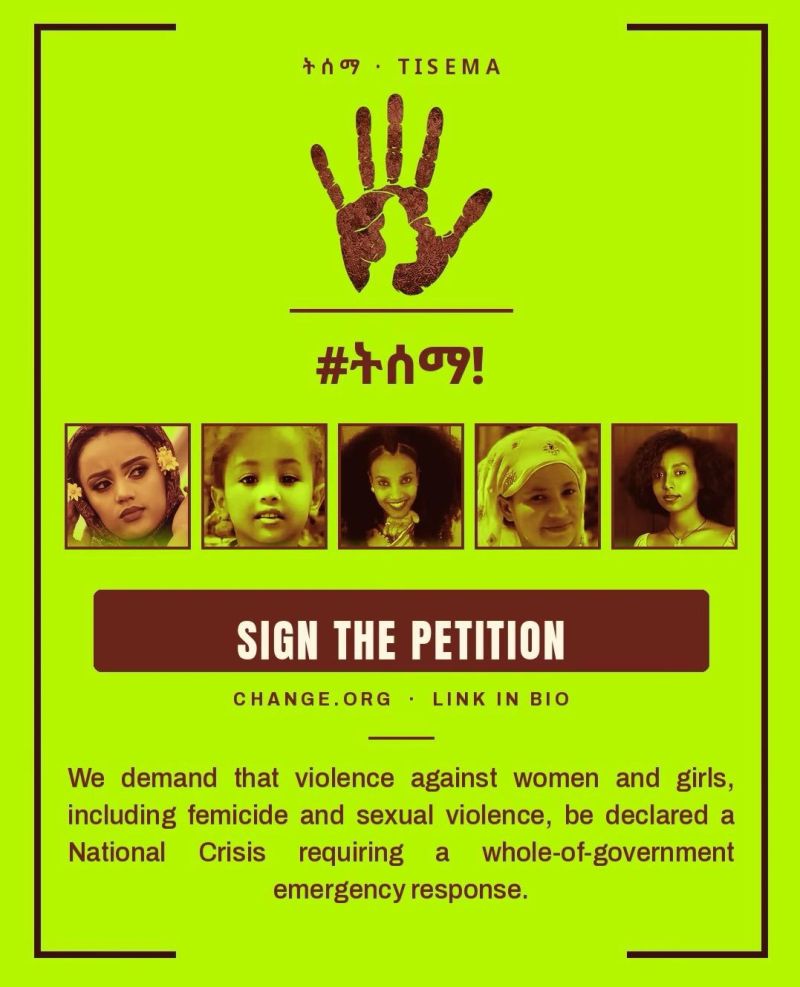
These disparate acts of violence—stretching from the conflict-torn rural woredas of Oromia to the highest courts of Ethiopia’s major cities—have coalesced into an unprecedented structural emergency. A synthesis of findings from Amnesty International and the grassroots advocacy movement #TISEMA (#ትሰማ, meaning “Let Her Be Heard”) reveals a nation where systemic impunity, fractured judicial frameworks, and widespread wartime atrocities have left women exposed to unpunished abuse. With a public petition amassing over 106,000 shares and thousands of endorsements, campaign leaders and human rights monitors are demanding that the Ethiopian government formally declare violence against women and girls a National Crisis requiring immediate, whole-of-government intervention.
Ethiopia: Wartime Atrocities and the Weaponisation of Sexual Violence in Oromia
According to a briefing by Amnesty International, titled “No One Came to My Rescue”, non-international armed conflict raging since 2019 between the Oromo Liberation Army (OLA)—also known as Waraana Bilisumma Oromoo (WBO)—and the Ethiopian National Defense Forces (ENDF) alongside regional security forces has transformed rural Oromia into a zone of terror for women. Amnesty International documented severe cases of Conflict-Related Sexual Violence (CRSV), including gang rape, sexual slavery, and torture across the Sayo and Anfilo woredas of the Kellem Wallaga zone.
The investigation revealed a calculating pattern of sexual violence used as a tool of reprisal. Five of the ten survivors interviewed by Amnesty International reported being explicitly targeted because their male relatives were forcibly conscripted into local government militias. Another survivor, Dureti, described being raped by an ENDF soldier in a shop while neighbours listened to her screams without intervening, only to be abducted and gang-raped two months later by six OLA fighters in retaliation. “He [the ENDF soldier] raped me while I was screaming for help,” Dureti recalled. “He raped me while the entire neighbourhood was listening to me scream. No one came to my rescue.”
The human cost of these war crimes is catastrophic. All survivors interviewed by Amnesty International reported enduring long-term sexual and reproductive health complications, including traumatic fistulas, untreated sexually transmitted infections, and severe physical disablement. Yet, deep-seated social stigma, fear of community ostracisation, and direct threats from OLA fighters—who actively target healthcare providers offering post-rape or abortion care—prevent many survivors from seeking life-saving medical treatment at local one-stop centres.
Mass Displacement and the Systemic Collapse of Rural Civil Society
The surge in targeted sexual violence and punitive house-burnings has precipitated a sweeping demographic catastrophe across western Ethiopia. Joint assessments by United Nations agencies, including UNHCR and IOM, confirm that conflict and gender-based violence remain the primary drivers of internal displacement across the four Wallaga zones (East, West, Kellem, and Horo Guduru), where conflict has displaced hundreds of thousands of people. In the Kellem Wallaga zone alone, over 103,000 individuals have been forced from their homes, with female-headed households bearing the brunt of the hardship.
Data compiled by UN humanitarian bodies indicates that out of the displaced population in Kellem Wallaga, 52,686 are women, and over 18,150 children face extreme risks of rape, child marriage, female genital mutilation, and family separation. Humanitarian experts visiting the region confirm that rural communities have effectively been emptied of their female population. “Women cannot live in the rural areas [of Kellem Wallaga zone] anymore,” noted a humanitarian expert cited in the Amnesty International report, describing a mass exodus to urban centres where displaced women are pushed into low-wage daily labour for survival.
Fighters from the OLA have systematically torched homes and threatened executions to force civilians to flee, an act that Amnesty International notes constitutes the war crime of forcible expulsion under customary international humanitarian law. Yanet, a CRSV survivor whose family home was burnt down in December 2022, described the total destruction of her family’s livelihood: “Before the incident, we used to lead a good life. Our family is now dismantled. We are not living together anymore… Now we are displaced, our home is burnt, and we have lost everything.”
Lost Files and Institutional Failure: The Urban Femicide Emergency
While rural women face weaponised violence in conflict zones, urban women confront an equally precarious reality defined by intimate partner violence, opaque court proceedings, and systemic legal failures. According to data cited by the #TISEMA campaign, over 31% of ever-married women in Ethiopia experience intimate partner violence—a statistic that has remained unchanged over the past decade. Furthermore, while overall national homicide rates have dropped, the proportion of intentional homicides targeting women in urban centres has surged dramatically.
Campaigners point to a disturbing string of high-profile cases where Ethiopia’s judicial system failed to deliver justice. Following the killing of Zewdu Haftu in Mekelle, the Central Court of Mekelle released her admitted killers—Yared Gebreselassie and Angesom Hailemariam—after a key evidence file mysteriously vanished from the court registry. In March 2025, 25-year-old engineer and social media influencer Keneni Adugna died after falling from a fifth-floor apartment shared with her partner, musician Andualem Gosa; despite documented evidence of prior physical abuse, Gosa was released without trial due to an alleged “lack of evidence”.
These cases, alongside those of young Heaven Awot and survivors such as Ikram and Liza, have exposed structural fractures within Ethiopia’s justice system. Decades of political instability, paired with a tightening national crackdown on civil society organisations and independent journalists, have left survivors with few avenues for redress or protection.
The #TISEMA Campaign Demands Whole-of-Government Emergency Action
In response to this multi-front emergency, the #TISEMA movement has rallied tens of thousands of citizens behind a petition demanding that the Ethiopian government formally declare violence against women and girls a National Crisis. The petition argues that treating VAWG as a series of isolated incidents rather than a structural emergency enables ongoing impunity and delays vital state intervention.
To operationalise the proposed emergency declaration, campaigners are calling for four structural reforms:
- A Named Accountable Office: Establishing an oversight body positioned above line ministries to coordinate a unified national response.
- Transparent Budget Lines: Securing dedicated public treasury funding in official accounts for prevention, protection, and survivor support services.
- Enforceable Timeframes and Reporting: Implementing strict delivery schedules and mandatory public updates to prevent crucial evidence files and policy roadmaps from disappearing.
- Immediate Framework Transparency: Releasing the National Policy on Women’s Empowerment and Gender Equality alongside outstanding domestic violence data chapters.
Amnesty International has echoed these structural demands, urging the federal government to conduct independent, credible investigations into atrocities committed by both OLA fighters and ENDF forces, while calling on OLA command to immediately order an end to sexual violence, disarm perpetrators within its ranks, and stop the harassment of healthcare workers.
For the survivors living in informal displaced shelters or mourning lost family members, true justice remains tied to peace, systemic accountability, and the restoration of safety. Hawetan, an 18-year-old survivor of CRSV from Oromia, summed up the lingering hope of thousands across the country: “I hope they [the OLA fighters] will return to their home and we will have peace. That is how what happened to me can end.” Another survivor reflected on the path forward, telling researchers: “I consider peace to be justice. I wish we could live together after reconciliation.”


