
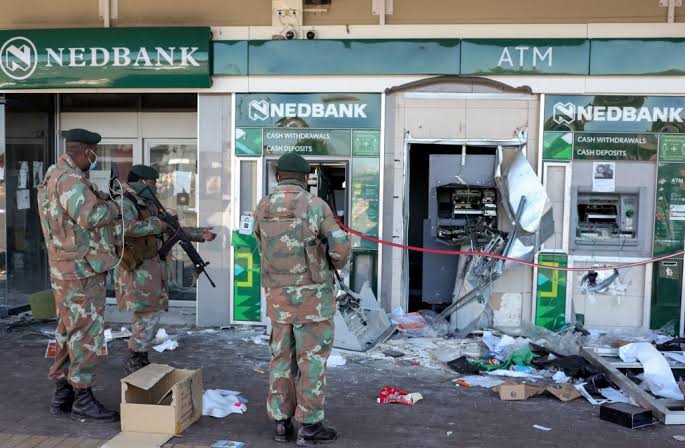

South Africa’s largest banks are reshaping their cash networks as customers move to digital banking, with three of the country’s five biggest lenders cutting their ATM footprints since 2023 even as Capitec expands aggressively.
According to local reports, Nedbank has reduced its ATM network by 4.4% since 2023 to 4,014 machines, while Absa’s network has fallen 2.7% to 6,240. FNB’s network has remained broadly flat, slipping 0.3% to 4,775. Standard Bank, by contrast, has increased its ATM count by 1.3% to 3,496, while Capitec has expanded its cash-device network by 11.4% to 8,798. The overall network of the five banks grew by 2.2% between 2023 and 2025, largely due to Capitec’s expansion.
The retreat from ATMs reflects a broader shift towards online and mobile banking, which allows lenders to serve customers without the costs associated with maintaining extensive physical infrastructure. Cash handling also carries significant security costs in South Africa, where cash-in-transit vehicles remain a target for organised criminals. The country recorded 31 cash-in-transit heists in the first three months of 2026.
Capitec has taken a different view of the cash market. Its network includes more than 7,000 ATMs alongside cash and coin recyclers and dual-note recyclers. Cash transactions at the bank rose from R596mn in 2024 to R619mn in 2025, suggesting that physical currency remains commercially relevant despite the rapid adoption of digital payments.
Banks are also using fintech and retail networks to reduce customers’ reliance on conventional ATMs.
In 2025, Nedbank’s acquisition of iKhokha strengthened its offering to small businesses, including spaza shops, by enabling merchants to accept card and mobile payments through point-of-sale technology. Some banks are encouraging customers to withdraw cash at retail tillpoints, where fees can be substantially lower than at ATMs. Digital-only lenders such as Discovery Bank have gone further, operating without traditional ATM or branch networks.
The migration to digital banking is not without costs. More than 21mn South Africans use mobile banking applications, creating a large pool of potential targets for cybercriminals. Boris Larin, chief security researcher at Kaspersky, said attackers increasingly sought users’ credentials, devices and communications through phishing, social engineering, infostealers and mobile banking trojans. Such malware can capture banking credentials, card details, cookies and other sensitive information, potentially enabling account takeovers and financial fraud.
Kaspersky said mobile banking attacks increased 1.5 times globally in 2025, while bank-related phishing accounted for 53.75% of phishing detections in Africa. The company also found credentials associated with more than 1mn online banking accounts at the world’s 100 largest banks had been compromised by infostealers last year.
NordVPN separately identified more than 263mn browser cookies linked to South African users in infostealer datasets, highlighting the wider exposure created by the digitisation of financial and consumer services.
South Africa’s banking sector is therefore moving towards a more fragmented cash market: traditional ATM networks are being rationalised, fintech is bringing electronic payments to previously cash-dependent businesses, and some lenders are continuing to invest in physical cash infrastructure where demand remains strong. The strategic challenge for banks will be to capture the cost savings of digital banking without leaving customers dependent on increasingly vulnerable digital channels.


