
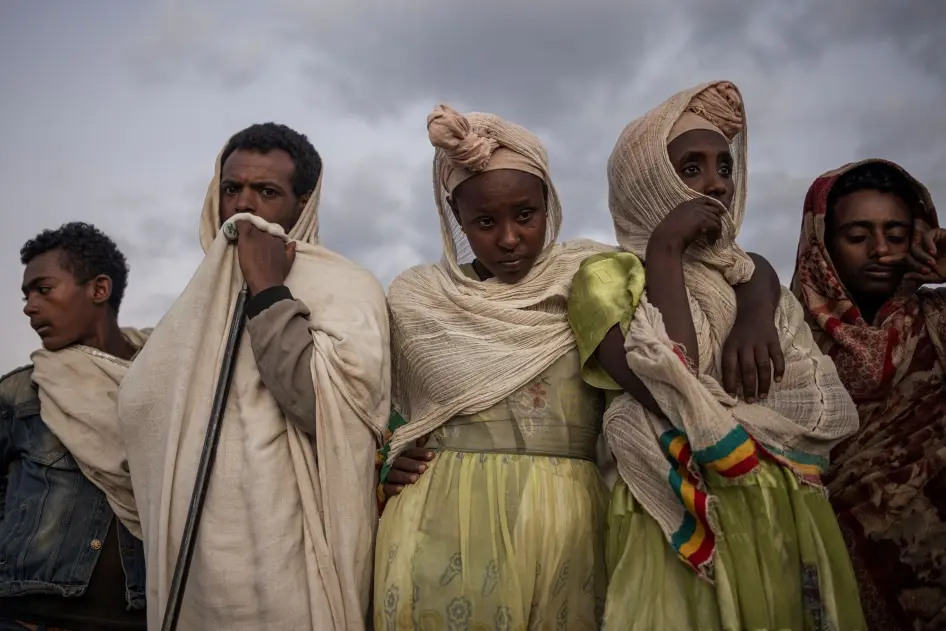

In mid-2023, the federal government of Ethiopia launched what has escalated into a full-scale war in the Amhara region. The conflict was triggered by Addis Ababa’s decision to dissolve regional special forces—including many Amhara officers—and subsume them under federal military or police command. Many refused, choosing instead to join Fano, a network of loosely organized local militias. What began as protests rapidly spiraled into open armed conflict.
Once allies in the war against Tigrayan rebels, Fano fighters and the federal army turned on one another. From July 2023 onward, towns across Amhara were engulfed in crossfire. The government declared a state of emergency, severed communications, and subjected the region to shelling, drone strikes, and martial law.
However, this war has targeted more than just combatants. Anyone perceived—often arbitrarily—as a supporter of Fano has become a potential target. Consequently, the region has become a landscape of mass suffering, displacement, and systematic human rights abuses.
Civilian Casualties, Terror Tactics, and the Collapse of Normal Life in Amhara
A Lethal Sky: Drone and Air Strikes
Since 2023, air power has become a central instrument of the government’s campaign. Drone and air strikes have repeatedly struck civilian neighborhoods, homes, and public infrastructure.
A stark example occurred in early August 2023, when a drone strike on Finote Selam killed approximately 30 people and wounded more than 55. Local authorities recorded dozens of additional casualties, including women and children. Rights groups have warned that many of these attacks appear to be “collective punishment” rather than legitimate military operations—a pattern irreconcilable with international humanitarian law.
Street-by-Street Terror: Extrajudicial Killings
Ground forces have also been implicated in egregious abuses. In late January 2024, in the town of Merawi, soldiers allegedly carried out house-to-house raids and mass executions of civilians in retaliation for an earlier Fano attack. Witnesses described gunfire in the streets, the looting of property, and the slaughter of entire families.
Independent investigators estimate the death toll at between 50 and 100, including women and minors indiscriminately labeled as combatants. These recurring incidents illustrate a harrowing pattern of summary executions, revenge killings, and state-sponsored terror.
The Collapse of Essential Services
The war has dismantled the region’s social safety net. Security forces have attacked and looted health facilities, detained medical staff, and disrupted care. Pregnant women, the sick, and children have lost access to essential services. Simultaneously, schools have closed, leaving thousands of children without education.
With towns in ruin and infrastructure destroyed, displacement is rampant. Food insecurity and reliance on humanitarian aid are now pervasive among millions. In many parts of Amhara, normal life has collapsed, replaced by fear, deprivation, and a daily risk of death.
War on Amhara: Does it Amount to Genocide?
Whether the events in Amhara legally constitute “genocide” remains a contested issue among scholars, governments, and human rights bodies. International organizations often hesitate to apply the term without incontrovertible proof of intent to destroy an ethnic group in whole or in part.
Nevertheless, the indicators are undeniable. As early as 2023, the UN’s top genocide-prevention official warned that the patterns of killing, displacement, and group targeting in Amhara, Tigray, Afar, and Oromia met many of the risk factors for “atrocity crimes.”
Several independent analyses assert that the scale and systematic nature of these abuses—extrajudicial killings, drone strikes on civilians, and the destruction of property—are consistent with crimes against humanity and potentially genocide. At a minimum, what is unfolding is a brutal, large-scale humanitarian disaster tearing at the fabric of the Amhara region.
The Human Cost and the World’s Silence
Behind every statistic is a shattered life: children orphaned, survivors traumatized, and families buried under rubble. In Merawi, one woman recounted soldiers dragging her husband into the street and demanding their baby, only to execute the father in front of his newborn.
Thousands struggle to access food, shelter, or medical care. With health centers ruined and roads blocked, many towns are cut off from aid. Displaced families wander uncertain paths, having lost their livelihoods, homes, and hope of return. The psychological toll—grief, fear, and despair—is incalculable.
Impunity and Complicity
Perhaps the most troubling aspect of this tragedy is the near-total impunity for perpetrators. Despite repeated calls for accountability, few meaningful steps have been taken. Access to the region is heavily restricted by internet blackouts and media bans that prevent independent reporting.
Meanwhile, the international community has failed to act decisively. Warnings from UN envoys regarding atrocity crimes remain largely unheeded. For the victims in Amhara, this silence from global capitals and human rights bodies is as deadly as the violence itself.
Why We Must Care
The war in Amhara is no longer just a “local conflict.” It is a humanitarian crisis that challenges global norms, raising fundamental questions about ethnic identity, state power, and the protection of civilians. If left unchecked, history suggests this violence will spiral—hardening divisions and making displacement permanent.
Worse, it risks normalization. The world cannot allow the bombing of civilians and mass killings to be dismissed as “just another African war.” Every innocent life lost is a failure of humanity.
What Needs to Happen Now
- Full, Independent Investigation: The allegations of extrajudicial killings, sexual violence, and drone strikes require thorough documentation. Bodies such as the UN Human Rights Council (UN-HRC) or the ICC must be empowered to investigate.
- Humanitarian Access: Aid must reach those trapped by conflict. Medical workers, hospitals, and schools must be protected under international law.
- Accountability: States and global institutions must impose consequences—sanctions, arms embargoes, and diplomatic pressure—on actors who violate human rights with impunity.
- Support for Survivors: Physical and psychological rehabilitation and the safe return of displaced persons must become a priority.
Above all, we must not forget. To forget is to enable further killing and to betray our common humanity. The war on Amhara is not over, but the story of its people’s suffering—and their resilience—deserves to be told with truth and global solidarity.
Would you like me to draft a specific social media summary or a letter to a representative based on this Op-Ed?


