
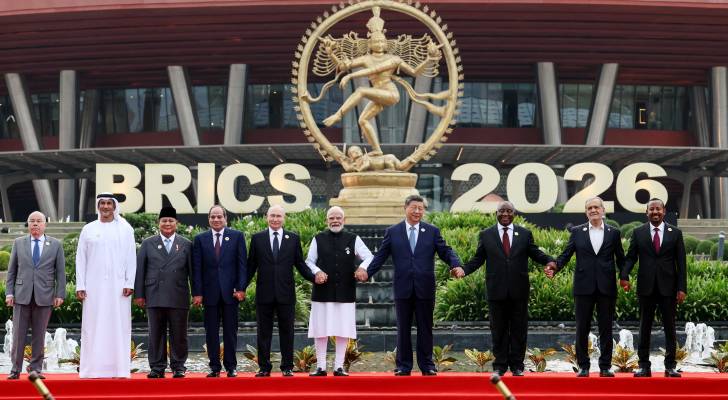

African BRICS members Nigeria, South Africa, Egypt and Ethiopia called for reforms to global institutions and stronger economic and technological cooperation at the 18th BRICS Summit in New Delhi.
The four countries used the summit to advance different priorities, including reform of international financial institutions, greater trade and investment, stronger artificial intelligence governance and expanded access to development finance.
Egypt’s President Abdel Fattah El-Sisi called for increased trade and investment among BRICS members and partners as part of efforts to strengthen economic resilience.
El-Sisi affirmed the importance of food and energy security, stable supply chains and greater access to development finance, while calling for stronger cooperation in technology, renewable energy and infrastructure.
He highlighted Egypt’s strategic position and the Suez Canal as important assets for strengthening trade and investment links between BRICS economies and global markets.
Nigeria called for a more representative global governance system, with Vice President Kashim Shettima urging reforms to the United Nations and international financial institutions.
Representing President Bola Tinubu at the summit, Shettima said Nigeria supports a global system that better reflects current political and economic realities, while calling for greater cooperation among developing countries.
He highlighted opportunities for BRICS cooperation in trade, investment, infrastructure, agriculture, energy, manufacturing and digital technologies, according to Premium Times.
Shettima said stronger South-South cooperation could help Nigeria attract investment, access new technologies and strengthen its productive capacity.
South African President Cyril Ramaphosa focused on the growing impact of artificial intelligence, calling for stronger governance and oversight of the technology within BRICS.
Ramaphosa proposed the establishment of an independent mechanism to assess AI systems and called for safeguards based on meaningful human oversight.
He warned that increasingly advanced AI systems could create risks ranging from cyber operations and mass surveillance to disruption in employment, while stressing their potential to improve healthcare, education, agriculture and scientific research.
Ramaphosa also called for greater investment in AI capabilities in developing countries to prevent the technology gap between advanced and developing economies from widening.
Ethiopian Prime Minister Abiy Ahmed called for deeper cooperation between BRICS and Africa, with a focus on trade, investment, development finance and economic transformation.
Abiy said Ethiopia was ready to strengthen its role within the bloc and support efforts to expand BRICS cooperation across Africa.
He also highlighted Ethiopia’s preparations to host the 32nd UN Climate Change Conference, COP32, in Addis Ababa in 2027, linking the country’s BRICS engagement to broader climate and development priorities.
The four African countries’ positions reflect the expanding role of BRICS as a platform for emerging economies to seek greater influence in global affairs while strengthening economic cooperation outside traditional channels.
The summit brought together BRICS members and partner countries to discuss trade, finance, technology, climate change and reform of the international system.
For African economies, the bloc provides an additional platform for pursuing investment, technology transfer, development financing and greater representation in global decision-making.


