

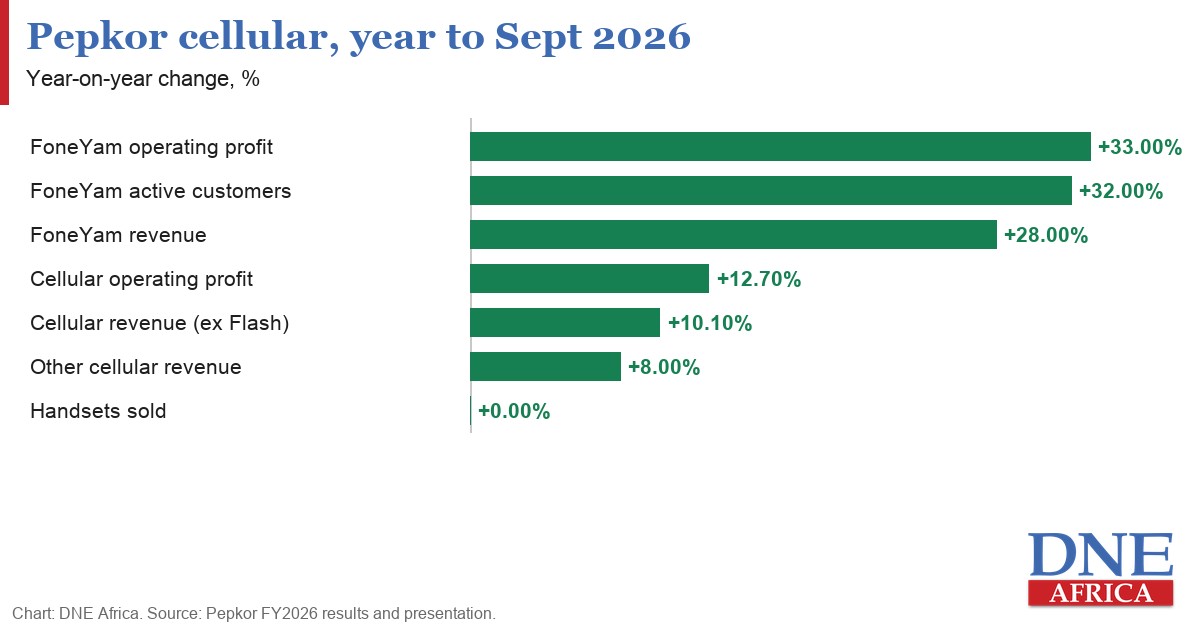
South African retailer Pepkor’s FoneYam smartphone rental business grew revenue 28% to R2.5bn ($143mn) in the year to September, while its handset sales were flat at 13.5 million, results showed on 24 November.
The shift matters because Pepkor, the owner of PEP and Ackermans, is South Africa’s largest seller of prepaid phones, and its customers are increasingly paying for smartphones by the month as device prices rise across the continent.
How fast is FoneYam growing?
FoneYam activated 2.5 million rental accounts during the year and ended it with 2.7 million active customers, 32% more than a year earlier, according to Pepkor’s reviewed annual results. Its cellular rental book grew to R3.1bn from R1.9bn.
Operating profit at FoneYam rose 33% to R700mn, according to the group’s results presentation, while revenue from the rest of the cellular business, which sells handsets, airtime, data and contracts, rose 8% to R19.5bn. That means FoneYam generated about a quarter of cellular operating profit from roughly 11% of cellular revenue, TechCentral calculated.
Repeat custom has been strong. Pepkor said 42% of customers who completed a first rental took out a second 18-month contract, a take-up rate it said exceeded expectations and effectively extends a FoneYam customer’s lifetime value by 18 months. FoneYam is available in more than 4,200 stores, and the presentation put its share of the smartphones Pepkor sold at 27%.
Are Pepkor’s phone sales slowing?
Unit sales have stalled. The 13.5 million handsets matched the previous year’s total, TechCentral reported, though the mix moved upmarket: smartphones made up 70% of handsets sold, up from 65%. PEP sold 9 million handsets, with smartphone sales up 6%, and Ackermans sold 3 million, the results show.
Total cellular revenue, excluding the Flash informal trading business, rose 10.1% to R22bn and operating profit 12.7% to R2.8bn, according to the presentation. Pepkor’s group revenue rose 11.9% to R105.9bn, with normalised headline earnings per share up 9.7%.
The flat volumes come as phone markets across Africa come under pressure. Research firm Omdia said this week that Africa smartphone shipments fell 40% in the third quarter as memory-chip costs pushed prices up, and South African computer distributor Mustek has said the memory chip shortage is lifting local device prices.
What does FoneYam mean for Pepkor’s plans?
Pepkor has moved FoneYam into a new financial services segment alongside its Capfin lending and Abacus insurance businesses and PlusB, through which it is building a bank. The company said that segment’s profit contribution passed R1bn, a year ahead of plan.
The rental model carries credit risk as well as reward. Pepkor’s debtors’ costs rose 28% to R5.3bn, though the company said growth had slowed sharply from 62% a year earlier and that it had moderated credit granting.
Outside its own shops, Pepkor’s Flash business distributed 38 million SIM cards, up 14%, with an active base of 3.1 million SIMs. Flash’s planned merger with township payments company Shop2Shop, to form a fintech group Pepkor intends to list, is before the competition authorities.
FAQ
What is FoneYam?
FoneYam is Pepkor’s smartphone rental service, launched in 2024 and sold through more than 4,200 PEP, Ackermans and other group stores. Customers pay monthly for a phone on an 18-month contract.
How many FoneYam customers are there?
FoneYam had 2.7 million active customers at 30 September 2026, up 32% on a year earlier, according to Pepkor.
How many phones did Pepkor sell in 2026?
Pepkor sold 13.5 million handsets in the year to 30 September 2026, the same as a year earlier, with smartphones making up 70% of the total.
Is FoneYam profitable?
Yes. Pepkor reported FoneYam operating profit of R700mn for the year, up 33%, on revenue of R2.5bn.


