
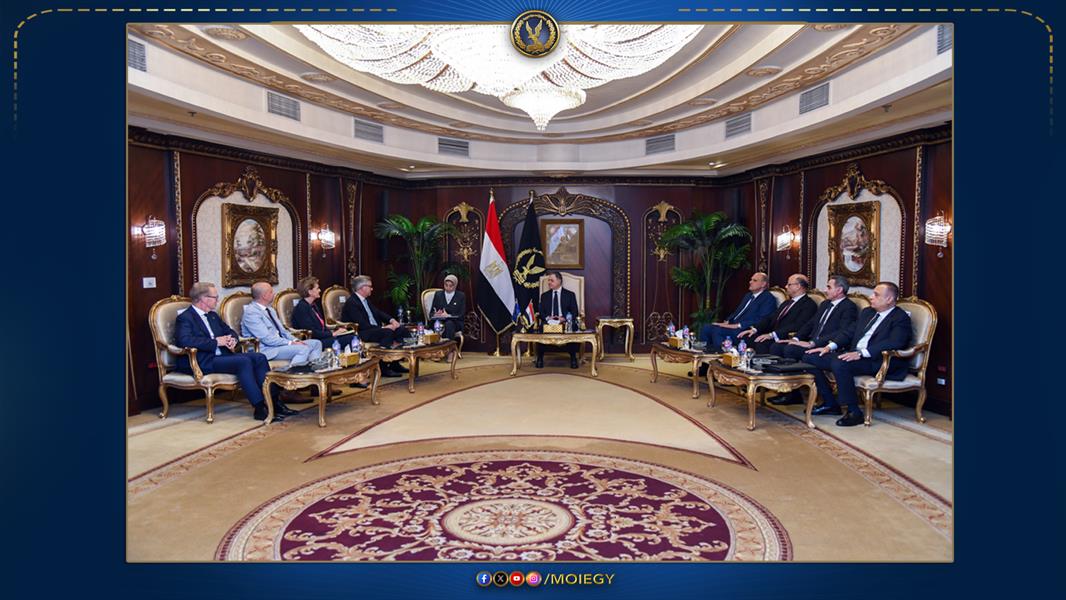

Egypt migration cooperation with the European Union moved a step further on 12 November, when the Interior Ministry signed a working arrangement with the EU’s police training agency, CEPOL, during a visit to Cairo by EU Commissioner Magnus Brunner.
The arrangement adds training to Egypt migration cooperation and a wider security relationship that already covers Europol and the EU’s border agency, Frontex, and comes as Brussels relies on partners in North Africa to manage migration routes towards Europe.
Interior Minister Mahmoud Tawfik received Mr Brunner, the EU Commissioner for Internal Affairs and Migration, and his delegation at the ministry in Cairo, according to a statement from Egypt’s Ministry of Interior. The ministry said the talks ended with the signing of a document organising work between the ministry and the EU Agency for Law Enforcement Training, intended to support the exchange of expertise and capacity building on both sides.
Mr Tawfik stressed the need for joint efforts against terrorism and organised and cyber crime, given security challenges in the region and beyond, the ministry said. According to the same statement, Mr Brunner praised Egypt’s role in Africa and the Middle East and its work against irregular migration.
What did the EU and Egypt agree on migration cooperation?
The talks on Egypt migration cooperation covered migration management, migrant smuggling, human trafficking, drugs and firearms trafficking, and border management, according to a statement from the Delegation of the European Union to Egypt distributed by APO Group. They also covered Egypt’s work with EU agencies: Europol, CEPOL, Frontex and the EU Drugs Agency.
Mr Brunner later met Badr Abdelatty, the foreign minister, to discuss migration, the delegation said. Egyptian outlets including Youm7 and Sada El Balad reported the meeting and the signing on the same day (in Arabic).
“Criminal networks do not stop at borders, and neither can our response,” Mr Brunner said in the EU statement. He described the CEPOL arrangement as “another concrete step” towards breaking up smuggling rings and trafficking routes. Neither side published the text of the arrangement or any new funding figures for Egypt migration cooperation.
Why does Egypt matter to EU migration policy?
The EU calls Egypt a partner in the Global Alliance to Counter Migrant Smuggling and in its “Eastern Corridor” initiative, a route-based approach to migration from South Asia to North Africa. The delegation’s statement singled out Libya as the place from which many migrants on that route attempt the sea crossing to Europe. Irregular arrivals on the central Mediterranean route remain a political priority in Brussels, as shown by record landings elsewhere, such as the Canary Islands migrant arrivals this week.
Egypt migration cooperation and wider ties rest on the Strategic and Comprehensive Partnership signed in March 2024, which came with a financial and investment package of €7.4bn for 2024 to 2027. According to the joint statement of the first EU-Egypt summit, held in Brussels on 22 October 2025, that package is made up of €5bn in concessional loans, €1.8bn of investment to be mobilised and €600mn in grants.
Egypt’s security cooperation with EU agencies has grown alongside it. In April 2025 the Interior Ministry signed a working arrangement with Europol, the first such deal between the EU police agency and an African country, according to Europol. Europol said that arrangement does not provide a legal basis for transferring personal data. Rights groups have questioned the EU’s police cooperation with Egypt; the government says the work targets terrorism and organised crime.
What happens next for Egypt migration cooperation?
The CEPOL arrangement is expected to lead to training and exchange programmes between the agency and Egyptian police, though no schedule has been published. Further steps in Egypt migration cooperation are likely to be discussed under the 2024 partnership. Other EU partners in the region are on a similar track: Brussels is also pursuing migration talks with Nigeria, and international police operations against trafficking networks continue across the continent.
FAQ
What is CEPOL?
CEPOL is the European Union Agency for Law Enforcement Training, based in Budapest. It trains police and other law enforcement officers from EU member states and partner countries.
What did Egypt sign with CEPOL?
Egypt’s Interior Ministry signed a working arrangement with CEPOL on 12 November 2026 to support the exchange of expertise and capacity building, according to the ministry.
What does Egypt migration cooperation with the EU cover?
According to the EU, Egypt migration cooperation covers migrant smuggling, human trafficking, drugs and firearms trafficking, border management and work with Europol, CEPOL, Frontex and the EU Drugs Agency.
How much money is in the EU-Egypt partnership?
The 2024 Strategic and Comprehensive Partnership came with a €7.4bn package for 2024 to 2027, mostly concessional loans, according to the EU.


