

At least 591 tonnes of illicit gold, most of it from Africa, entered the United Arab Emirates in 2024 despite sourcing rules introduced the year before, according to a report published this week by Swissaid, a Swiss development group.
The finding matters for African producers because illicit gold is revenue their treasuries never see, and in countries such as Sudan it is a source of money for armed groups. The UAE has not responded to the report; it has previously said it has tightened its rules. The figures are Swissaid’s estimates, not official statistics.
What does the Swissaid report say about illicit gold?
The report, published by Swissaid, puts the value of the illicit gold at $74bn at current prices. That is 42 per cent of all the gold the UAE imported in 2024, the group says.
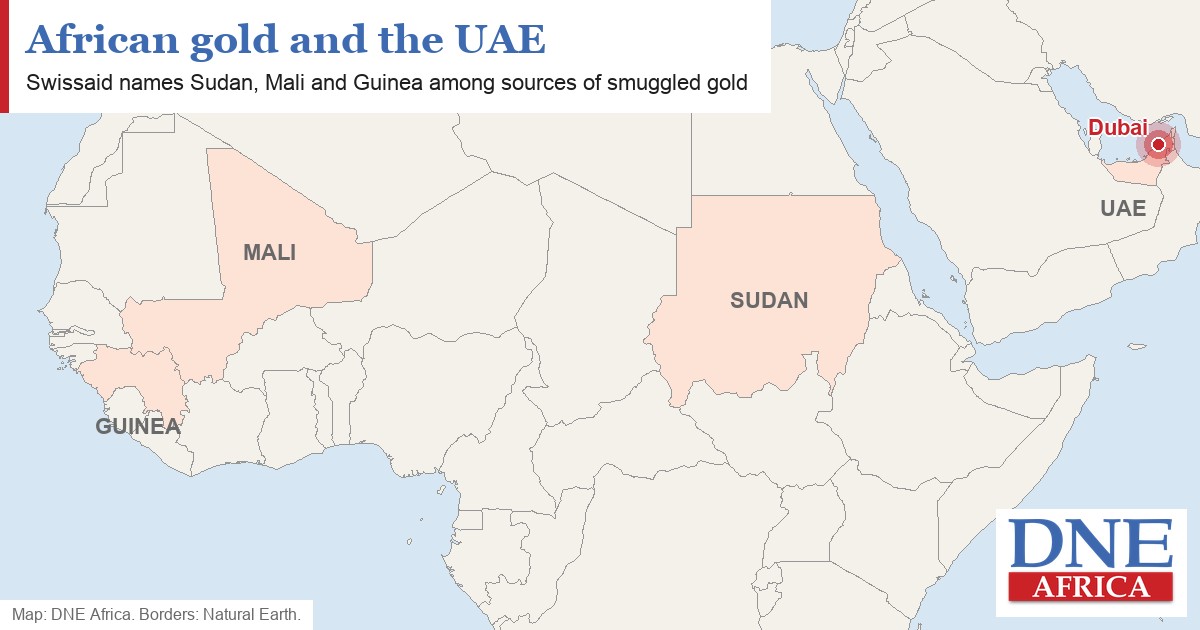
About 453 tonnes, worth more than $56bn, reached Dubai’s refineries from African producing countries including Guinea, Mali and Sudan, the Associated Press reported. A further 137.7 tonnes, worth nearly $17bn, came from Russia and Yemen, which are under international sanctions. Nearly 29 tonnes originated in Sudan.
Swissaid counts as illicit both gold smuggled out of the country where it was mined and gold from countries at war or under sanctions. Its researchers used UN and official trade data from 2021 to 2025 and interviewed more than 150 people in the trade, according to Middle East Eye. The authors said data for 2025 was incomplete but pointed the same way.
Why does illicit gold matter for African producers?
A large share of Africa’s gold is dug by artisanal miners and sold to traders rather than to licensed exporters. When that metal crosses a border undeclared, the producing state loses royalties, export taxes and foreign currency.
The scale is large. About 70 per cent of the gold extracted in Africa was shipped to the UAE in 2024, and more than half of the UAE’s gold imports in 2024 and 2025 came from African countries, Middle East Eye reported, citing the study. For Sudan, Niger, the Central African Republic, Zimbabwe, Libya, Togo and Cameroon, more than 95 per cent of the gold that trading partners declared as imports went to the UAE.
An earlier Swissaid study found that more than 2,500 tonnes of smuggled gold, worth over $115bn, left Africa for the Emirates between 2012 and 2022.
Governments have begun to act against unlicensed mining, at a cost. Guinea announced restrictions on unauthorised gold mining this month, and clashes during a patrol in the Siguiri region killed 10 people, the Guinean government said, according to the Associated Press.
How does illicit gold connect to Sudan’s war?
Sudan’s output is dominated by artisanal miners working in areas held by both the army and the Rapid Support Forces, the report says. Gold from paramilitary-held areas is smuggled out through South Sudan, Chad, the Central African Republic, Ethiopia or Kenya, and gold from army-held areas mainly through Egypt, before most of it is exported to the UAE, according to Middle East Eye’s account of the findings.
The UAE denies backing the Rapid Support Forces and says its role in Sudan is humanitarian. The war continues: officials said on Friday that the army had retaken El Khuwei in West Kordofan.
What has the UAE said, and what does Swissaid want?
The UAE introduced rules in 2023 requiring refiners and traders to check where their gold comes from. It did so after the Financial Action Task Force, the global anti-money laundering body, placed it on a watchlist; it was removed in 2024. Of 52 Emirati refineries reviewed, only two fully applied the new rules, Mining.com reported, citing the study.
The UAE did not immediately respond to the Associated Press’s request for comment. Responding to an earlier Swissaid report, an Emirati official said the country had taken significant steps on gold smuggling and brought in new regulations on precious metals, Middle East Eye said.
“We had hoped that with the new regulations, conflict gold from countries subject to international sanctions would be stopped,” Marc Ummel of Swissaid told the Associated Press.
To curb illicit gold, Swissaid recommends that the task force put the UAE back on its list, that penalties for non-compliance be raised and made public, that Emirati companies name their suppliers of mined gold, and that customs checks be stepped up. Any decision on the watchlist rests with the task force’s member governments.
FAQ
How much illicit gold entered the UAE in 2024?
At least 591 tonnes, worth about $74bn at current prices, according to Swissaid’s estimate. About 453 tonnes came from African producing countries.
Which African countries are named as sources of illicit gold?
Guinea, Mali and Sudan are named among the main sources. Nearly 29 tonnes originated in Sudan, the report says.
Are these official figures?
No. They are estimates by Swissaid based on UN data, official trade statistics and interviews.
How has the UAE responded?
It had not responded to this report at the time of writing. It has previously said it has taken significant steps against gold smuggling.


